





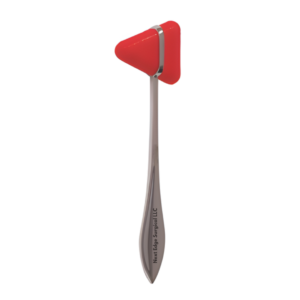
Buck Reflex Hammer for Neurological Exams – 01-130-18
Deep tendon reflex testing provides valuable information about the function of peripheral nerves, spinal pathways, and associated muscle responses. During neurological examinations, clinicians use controlled percussion to observe involuntary movements and identify differences between corresponding reflexes.
Our Buck Reflex Hammer – 01-130-18 is an 18.5 cm neurological examination instrument featuring a rubber striking head and pointed tip. Its compact configuration supports focused reflex assessment during routine medical examinations and clinical screening.
Compact Buck Pattern for Controlled Neurological Testing
The Buck hammer is designed for tendon percussion using a short, deliberate striking movement. Its compact length allows clinicians to position the instrument conveniently when examining patients in consultation rooms, hospital wards, and other clinical environments.
This surgical diagnostic instrument supports examination of patellar, Achilles, biceps, and triceps reflexes. The pointed end also provides an additional contact surface for appropriate localized neurological assessment.
Features and Benefits
| Feature | Benefit |
| Buck reflex hammer pattern | Supports conventional neurological reflex examination. |
| 18.5 cm overall length | Provides a compact configuration for controlled handling. |
| Rubber striking head | Allows tendon percussion during clinical assessment. |
| Pointed testing tip | Supports appropriate localized sensory or cutaneous examination. |
| Deep tendon reflex application | Helps clinicians observe involuntary muscle responses. |
| Compact examination design | Convenient for repeated assessments in clinical environments. |
Instrument Care and Handling
Inspect the rubber head, pointed tip, and handle before every examination. Look for surface damage, loose components, or contamination that could affect safe patient contact.
Explain the procedure and position the patient comfortably. Encourage muscle relaxation because voluntary tension may influence the response elicited during percussion.
For patellar reflex assessment, identify the patellar tendon and apply a controlled strike. Observe the resulting quadriceps contraction and lower leg movement.
When examining the Achilles reflex, support the foot appropriately and observe plantar flexion following tendon percussion. Compare findings with the opposite limb.
Upper extremity examinations may include biceps and triceps reflexes. Maintain consistent positioning and use sufficient force to produce an interpretable response without unnecessary discomfort.
The pointed tip can support selected localized neurological tests when used with appropriate examination technique. Avoid excessive pressure against sensitive skin.
Record reflex findings using the grading method adopted by the healthcare facility. Interpret responses alongside muscle strength, sensation, and other neurological observations.
After examination, remove visible contamination and disinfect patient-contact surfaces using compatible cleaning products.
Protect the rubber head from sharp objects, excessive compression, and unnecessary impact. Keep the pointed tip secure during transportation.
Store the instrument in a clean, dry examination tray. Periodic inspection helps maintain suitable working condition during repeated clinical assessments.
Product Specifications
| Specification | Details |
| Product Name | Buck Reflex Hammer for Neurological Exams |
| SKU | 01-130-18 |
| Brand | Next Edge Surgical LLC |
| Category | Diagnostic Instruments |
| Instrument Pattern | Buck |
| Overall Length | 18.5 cm |
| Striking Head | Rubber |
| Additional Working End | Pointed Tip |
Frequently Asked Questions
What is the Buck reflex hammer used for?
Deep tendon reflex testing during neurological examinations.
What is the overall length?
18.5 cm.
Does this model feature a rubber head?
Yes, it has a rubber striking head.
Can it support localized neurological testing?
Yes, through its pointed testing tip.
How should the hammer be maintained?
Clean contact surfaces and inspect the working ends regularly.
Reviews
There are no reviews yet.