



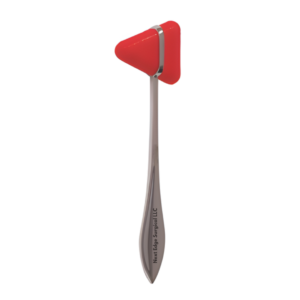
Buck Hammer for Reflex Testing – 01-131-18
A complete neurological examination includes more than evaluating muscle strength and sensation. Deep tendon reflexes help clinicians assess the integrity of reflex pathways and identify findings that may indicate neurological dysfunction.
Our Buck Hammer for Reflex Testing – 01-131-18 belongs to the traditional Buck neurological percussion instrument family. It supports controlled tendon stimulation during physical examinations, neurological screening, and clinical teaching.
Buck Reflex Testing in Routine Physical Examinations
The Buck pattern is associated with compact reflex hammers used to elicit involuntary muscle responses. During examination, the clinician applies a brief, controlled strike to a tendon and observes the resulting movement.
As a surgical diagnostic instrument, this model supports systematic evaluation of common deep tendon reflexes. The instrument can be incorporated into general physical assessments, focused neurological examinations, and follow-up evaluations involving reflex comparison.
Features and Benefits
| Feature | Benefit |
| Buck neurological pattern | Supports established tendon percussion techniques. |
| Deep tendon reflex application | Helps assess involuntary muscle responses. |
| Upper limb examination | Supports biceps and triceps reflex assessment. |
| Lower limb examination | Allows patellar and Achilles reflex testing. |
| Bilateral assessment | Helps clinicians compare corresponding reflex responses. |
| General clinical application | Suitable for neurological screening and examination training. |
Instrument Care and Handling
Begin by examining the striking surface and handle for visible deterioration or contamination. Check that the instrument can be handled comfortably and safely during percussion.
Explain the procedure before testing. Patient understanding and relaxation help minimize voluntary movements that could interfere with interpretation.
Select the tendon according to the examination objective. Position the relevant limb so that the muscle can respond naturally to the stimulus.
During patellar reflex testing, support the lower limb appropriately and strike the patellar tendon. Observe the resulting movement rather than relying on the patient’s reported sensation.
For Achilles reflex assessment, position the ankle suitably and observe plantar flexion after tendon percussion.
When testing the biceps or triceps reflexes, identify the correct anatomical landmarks. Maintain consistent technique when comparing responses between sides.
A reflex response may vary with patient position, muscle tension, and examination technique. Consider these factors when interpreting reduced, exaggerated, or asymmetrical findings.
Document results according to the neurological grading system used in the clinical setting. Combine reflex observations with other findings from the motor and sensory examination.
Clean and disinfect the patient-contact surfaces after use. Remove visible residue and maintain appropriate infection-control practices between examinations.
Avoid dropping the hammer or exposing its striking surface to unnecessary pressure. Protect the instrument during movement between consultation rooms.
Store it in a clean, dry diagnostic tray. Inspect its working surfaces periodically to identify damage before subsequent examinations.
Product Specifications
| Specification | Details |
| Product Name | Buck Hammer for Reflex Testing |
| SKU | 01-131-18 |
| Brand | Next Edge Surgical LLC |
| Product Category | Diagnostic Instruments |
| Instrument Type | Neurological Reflex Hammer |
| Instrument Pattern | Buck |
| Intended Application | Deep Tendon Reflex Testing |
| Examination Area | Upper and Lower Limbs |
Frequently Asked Questions
What does a Buck reflex hammer assess?
Involuntary muscle responses produced by tendon percussion.
Can it be used for knee reflex testing?
Yes, including assessment of the patellar reflex.
Why are both limbs examined?
To identify differences between corresponding reflex responses.
Is it useful during neurological screening?
Yes, as part of a structured physical examination.
What care does the instrument require?
Routine cleaning, inspection, and protected storage.
Reviews
There are no reviews yet.