


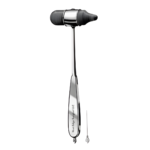



Dejerine Reflex Hammer for Neurological Exams – 01-124-20
Reflex examination provides valuable information about the integrity of neurological pathways. A controlled tendon strike can produce an involuntary muscle response, helping clinicians assess how sensory and motor components function together.
Our Dejerine Reflex Hammer – 01-124-20 follows a traditional neurological percussion pattern. Measuring 20 cm, it is intended for deep tendon reflex testing during routine physical examinations and focused neurological assessments.
Controlled Tendon Percussion With the Dejerine Pattern
The Dejerine hammer features a broad, flat striking head associated with controlled percussion. Its 20 cm length provides a practical instrument configuration for examining reflex responses at different anatomical locations.
This surgical diagnostic instrument supports clinical testing of the patellar, Achilles, biceps, and triceps reflexes. Observing response strength, symmetry, and consistency contributes to the wider neurological examination.
Features and Benefits
| Feature | Benefit |
| Dejerine hammer pattern | Supports established neurological percussion techniques. |
| 20 cm overall length | Provides a defined instrument size for clinical handling. |
| Broad, flat striking head | Supports controlled tendon stimulation. |
| Deep tendon reflex application | Helps clinicians evaluate involuntary muscle responses. |
| Bilateral examination use | Allows comparison of corresponding reflex responses. |
| Clinical education application | Supports instruction in neurological examination techniques. |
Instrument Care and Handling
Begin by examining the striking head and handle for visible wear, looseness, or contamination. Check the working surface before applying percussion to a patient.
Explain the reflex examination and encourage the patient to remain relaxed. Unnecessary muscle tension can affect the response and complicate interpretation.
For patellar reflex testing, position the lower limb appropriately and identify the patellar tendon. Apply a controlled strike and observe the resulting knee extension.
During Achilles reflex assessment, support the foot in a suitable position. Observe plantar flexion after percussion while comparing the response with the opposite limb.
Upper extremity testing requires attention to anatomical landmarks and limb positioning. The biceps and triceps reflexes should be examined using consistent technique.
Avoid excessive striking force. The purpose of percussion is to produce an observable reflex response, not discomfort or tissue injury.
Document the findings according to the clinical grading system used by the healthcare facility. Compare responses with other neurological observations, including muscle strength and sensation.
After patient contact, clean and disinfect the striking surface and frequently handled areas using suitable instrument-cleaning methods.
Protect the hammer from unnecessary impact during transportation. Keep the striking head away from sharp objects and equipment that could damage its surface.
Store the instrument in a clean, dry examination tray. Regular inspection supports continued use during neurological screening and clinical teaching.
Product Specifications
| Specification | Details |
| Product Name | Dejerine Reflex Hammer for Neurological Exams |
| SKU | 01-124-20 |
| Brand | Next Edge Surgical LLC |
| Category | Diagnostic Instruments |
| Instrument Pattern | Dejerine |
| Overall Length | 20 cm |
| Striking Head | Broad, Flat Pattern |
| Intended Application | Deep Tendon Reflex Examination |
Frequently Asked Questions
What is the Dejerine reflex hammer designed to assess?
Deep tendon responses during neurological examinations.
What is its overall length?
20 cm.
Which anatomical reflexes can be examined?
Patellar, Achilles, biceps, and triceps reflexes.
Why is controlled percussion important?
It helps produce interpretable responses without unnecessary force.
How should the hammer be stored?
Keep it clean, dry, and protected from impact.
Reviews
There are no reviews yet.