


How to Choose the Right Dental Extraction Tools

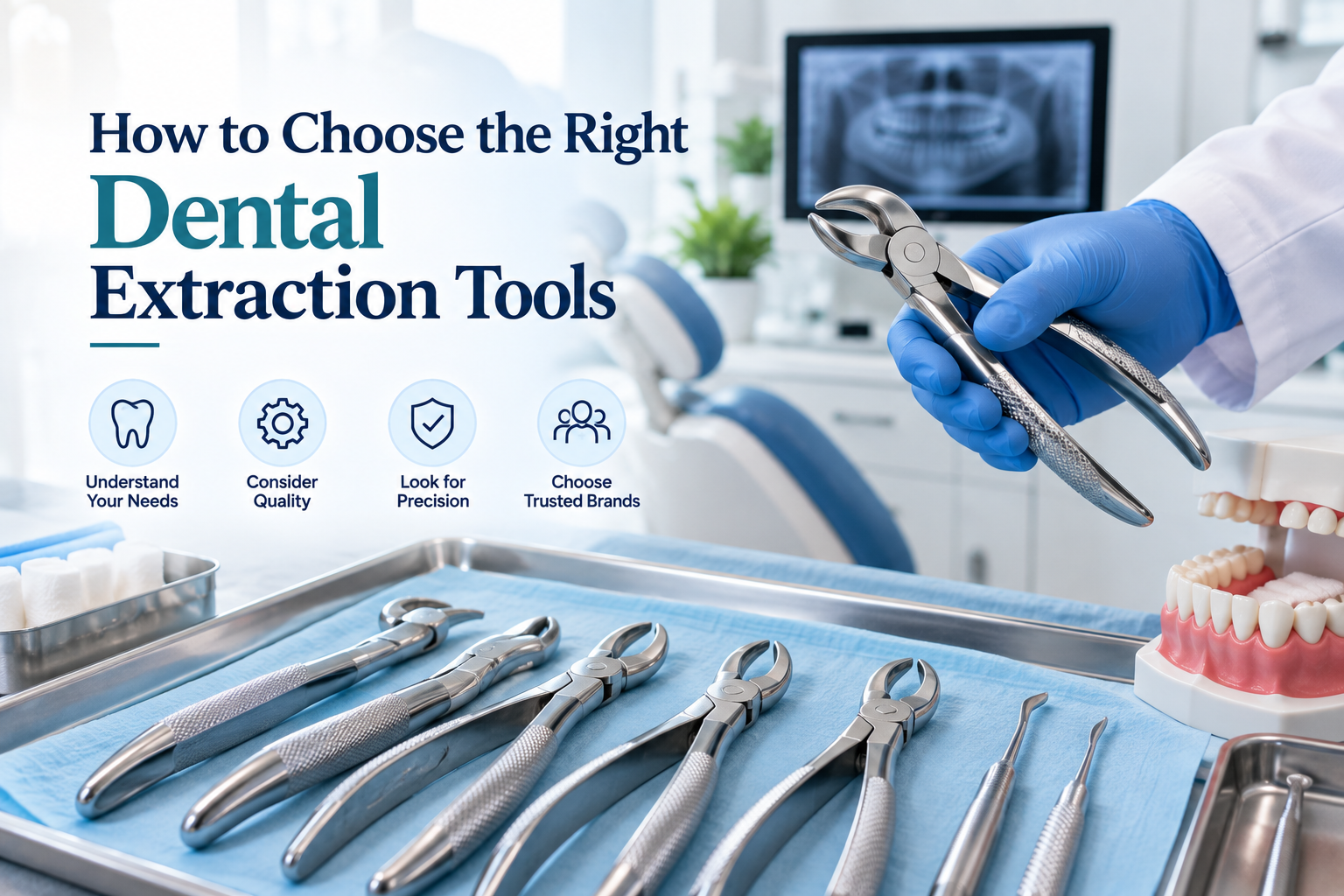
Usually, tooth extraction is a one-instrument procedure. Clinicians may use forceps, elevators, luxators, periotomes, or surgical instruments at different stages of treatment, depending on the tooth’s position, root form, condition, and access.
Each type performs a particular task, such as detaching the periodontal ligament, loosening the tooth or grasping and delivering it once it is mobile.
The main types of dental extraction tools, their differences, and factors to take into account while choosing or purchasing them are all covered in this article.
What Are Dental Extraction Tools?
Dental extraction tools are the instruments used to loosen, mobilize, grasp, and remove teeth or retained root fragments. The category covers extraction forceps, elevators, luxators, periotomes, and root-tip instruments, plus supporting surgical instruments for more complex cases.
The end goal of removing a tooth safely is the same across the category, but each instrument type gets there differently, which is why most extractions rely on more than one instrument in sequence.
Types of Dental Extraction Tools and Their Uses
- Dental Extraction Forceps
Extraction forceps grasp a tooth and deliver it from the socket once it’s adequately mobilized. Patterns are matched to tooth location and root anatomy, so maxillary and mandibular designs typically differ, with additional patterns for molars, roots, and pediatric teeth.
Common examples include #150 and #151 universal forceps, molar forceps, cowhorn forceps, and root forceps. Selecting a forceps pattern appropriate to the tooth and its anatomy is more important than relying on a generic instrument.
- Dental Elevators
Elevators come into play before forceps. Their job is to luxate the tooth, provide controlled leverage within the socket, and, in some cases, remove root fragments directly.
Straight and Coupland elevators, Cryer (east-west) elevators, cross-bar elevators and Warwick James elevators each offer a different working-end shape suited to particular access points and root configurations.
- Luxators and Periotomes
This is a distinction that’s often blurred in product listings, but the two instruments serve related, not identical, purposes. Luxators generally have thin, relatively sharp working ends built to enter the periodontal ligament space and help mobilize the tooth.
Periotomes, which frequently require less lateral force than a luxator, are made with narrow working ends specifically intended for periodontal ligament separation and controlled mobilization.
Because different manufacturers have different naming traditions, it’s important to consider the working-end design instead of just the product name alone.
- Root-Tip Instruments
When a root fragment remains after the crown has fractured or separated, root-tip elevators, root-tip picks and root forceps are designed to access and remove what’s left without unnecessary trauma to the surrounding bone.
- Surgical Instruments for Complex Extractions
Surgical extractions sometimes call for supporting instruments beyond the core extraction set: periosteal elevators for reflecting tissue, surgical curettes for debridement and rongeurs for trimming bone, along with surgical handpieces, burs and retractors.
These instruments support access and visibility; they aren’t substitutes for forceps or elevators.
Forceps vs. Elevators vs. Luxators vs. Periotomes
- Forceps grasp and deliver the tooth once it’s mobile.
- Elevators create controlled leverage to luxate the tooth and expand the socket.
- Luxators use narrow, sharp working ends to enter the periodontal ligament space and begin mobilization.
- Periodontal ligament separation with regulated, lower-force mobilization is the main goal of periotomes.
Depending on the tooth, its structure, and the accessible access, these devices are frequently utilized in various combinations.
How to Choose the Right Dental Extraction Tool
Usually, choosing an instrument depends on a few factors:
- Tooth location: Different forceps patterns are frequently required for maxillary and mandibular teeth.
- Tooth type and root anatomy: Different working-end designs may be required for incisors, premolars, and molars, particularly those with bent or fused roots.
- Crown condition: The way the tooth is approached is altered by a cracked or substantially restored crown.
- Access: A smaller or differently tilted instrument may be necessary due to restricted visibility or a tight arch.
- Extraction complexity: A straightforward extraction and a surgical extraction rarely call for the same instrument set.
- Operator technique: Instrument choice should fit the clinician’s established approach to that specific case.
#150 vs. #151 Extraction Forceps: What’s the Difference?
The #150 and #151 patterns are two of the most widely used universal extraction forceps. The #150 is generally associated with maxillary teeth, while the #151 is generally associated with mandibular teeth.
That said, tooth anatomy, root configuration, limited access, or manufacturer-specific design can call for a different pattern; #150 and #151 aren’t a fit for every extraction.
How Instrument Selection Can Support Controlled Extraction
Matching the instrument to the tooth affects how the extraction itself unfolds. Working ends that fit the tooth’s anatomy support more controlled force application and specialized instruments help where conventional grasping or access is limited.
The atraumatic extraction technique has gained attention in the literature for several reasons. One key factor is that extraction sockets experience significant dimensional changes due to bone resorption after a tooth is removed. Notably, buccal-plate bone loss is reported in a substantial share of cases, with a large portion of that loss occurring within the first year.
None of this means a given instrument prevents root fracture or guarantees an atraumatic result, but appropriately matched instrumentation is one factor clinicians weigh when trying to preserve surrounding tissue.
Cleaning, Inspection & Sterilization of Extraction Instruments
Extraction forceps, elevators and other instruments that penetrate soft tissue or bone are classified by the CDC as critical instruments. This classification means they require a defined reprocessing sequence of cleaning, packaging and heat sterilization, which must be performed correctly and in order every time, following the manufacturer’s validated instructions.
In practice, that means clearing debris promptly, inspecting hinges and working ends for wear or damage, packaging appropriately, sterilizing per facility protocol and storing instruments properly afterward.
What to Look for When Buying Dental Extraction Instruments
Before placing an order, there are several important factors to check. These factors include whether the supplier offers a complete range of correct patterns and configurations, as well as the accuracy of the working ends and smooth hinge movement and alignment. Additionally, consider corrosion resistance, clear manufacturer specifications, compatibility with standard reprocessing methods, and consistency across repeat orders.
When comparing suppliers, dental practices and procurement teams can evaluate documented specifications, instrument range, manufacturing quality and consistency across individual instruments and sets. Next Edge Surgical LLC is one option for professional dental and surgical instrument sourcing.
Choosing dental extraction tools isn’t just about picking the most common forceps off the tray. The right instrument depends on tooth anatomy, location, access and how complex the extraction is likely to be.
Understanding what each instrument category does makes it easier to build a practical, well-matched extraction setup.
Frequently Asked Questions
Forceps, elevators, luxators, periotomes and root-tip instruments cover most extractions, with surgical instruments like retractors and curettes added for more complex cases.
They're related but not interchangeable. Elevators are built for leverage and luxation, while luxators are designed with thinner, sharper ends to enter the periodontal ligament space.
Maxillary teeth generally call for different forceps patterns than mandibular teeth; the #150 and #151 universal forceps are common examples of that split.
Surgical extractions typically add periosteal elevators, retractors, curettes, rongeurs and surgical burs to the core extraction instruments.
As critical instruments, they should be cleaned, inspected and heat-sterilized after every use according to the manufacturer's instructions and applicable infection-control protocols.