


Surgical Instruments: Types, Names, Uses, Materials & Selection Guide

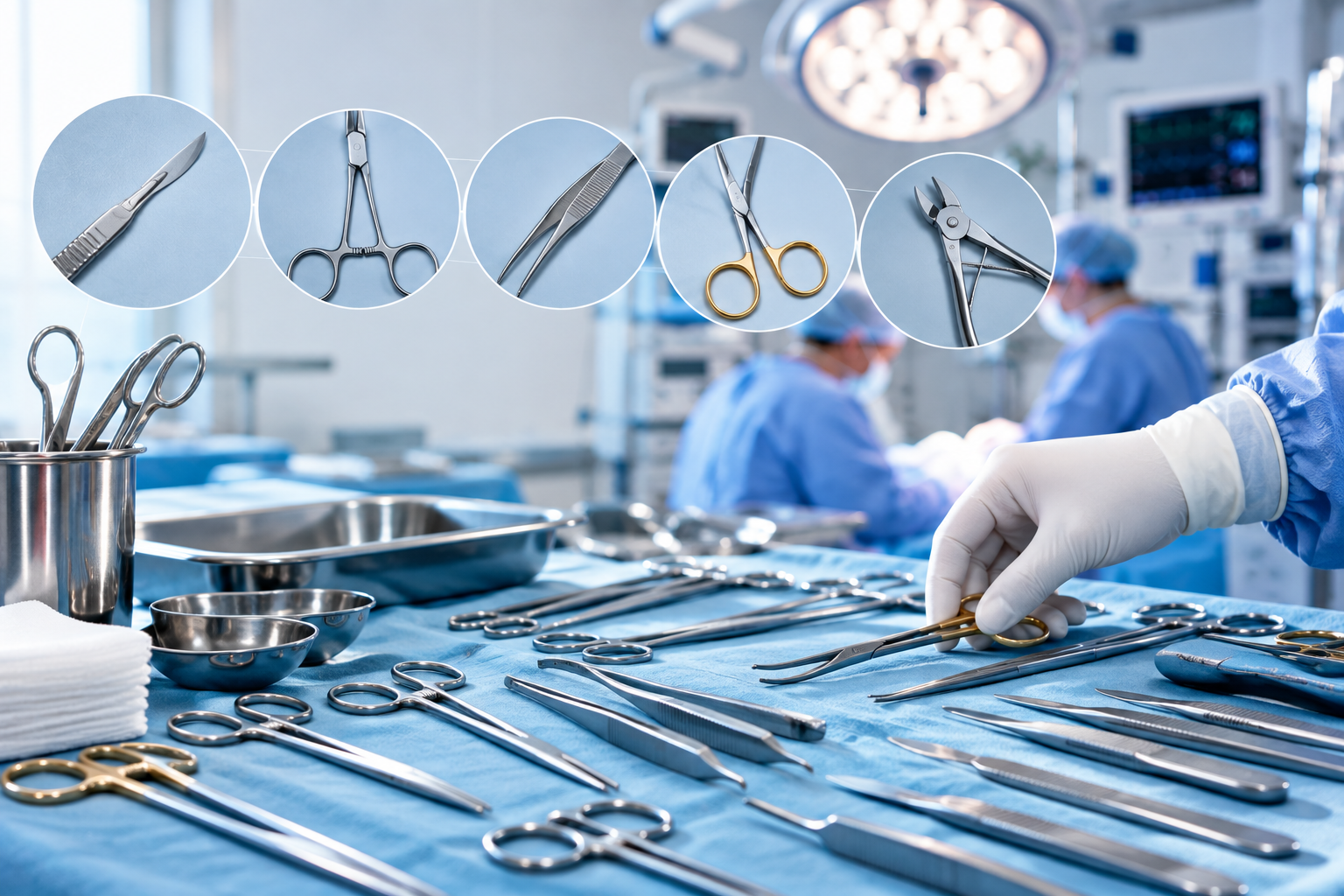
Surgical instruments are specialized tools used to cut, dissect, grasp, clamp, retract, suction, and suture tissue during operative procedures. Selecting the correct instrument matters because design, material, and function directly affect tissue handling, operative efficiency, and patient safety. Instruments differ according to specialty, procedure, tissue type, material, and intended use, and no single design works for every situation.
This guide covers the main types of surgical instruments, common names and uses, how similar instruments differ, materials, specialty applications, reprocessing, maintenance, and how to select the right instruments for a facility.
What Are Surgical Instruments?
Surgical instruments are tools designed to perform specific mechanical functions during surgery, cutting tissue, holding structures, or maintaining a clear operative field. Different designs exist because tissue types, procedures, and access points each demand a different mechanical approach.
Some instruments are reusable and built for repeated sterilization; others are single-use, intended for disposal after one procedure. General-purpose tools like scissors and forceps appear across many specialties, while others are built for one specific procedure.
Reusable instruments are also classified under the Spaulding infection-control framework as critical, semicritical, or noncritical, depending on whether they penetrate sterile tissue, contact mucous membranes, or touch only intact skin, a distinction that determines how each must be reprocessed.
Main Types of Surgical Instruments
These instruments are commonly classified by their primary function.
| Instrument Type | Primary Function | Common Examples |
| Cutting and dissecting | Cut or separate tissue | Scalpels, Mayo scissors, Metzenbaum scissors |
| Grasping and holding | Hold or manipulate tissue | Adson, DeBakey, Allis, Babcock |
| Clamping and occluding | Compress vessels or support hemostasis | Mosquito, Kelly, Kocher |
| Retracting | Maintain exposure of the operative field | Army-Navy, Deaver, Weitlaner, Balfour |
| Suctioning | Remove blood and fluids | Yankauer, Poole, Frazier |
| Suturing | Control needles during closure | Mayo-Hegar, Olsen-Hegar |
| Probing and dilating | Explore or enlarge openings | Probes, sounds, dilators |
Instruments within the same category aren’t interchangeable. A Kelly clamp and a mosquito forceps both clamp, but at different scales.
Common Surgical Instruments and Their Uses
- Scalpels and blades: A scalpel handle with a disposable blade is the primary cutting tool. A #10 blade suits larger incisions, a #11 is used for stab incisions, and a #15 offers fine control.
- Surgical scissors: Mayo scissors have a heavier blade for tougher tissue or suture; Metzenbaum scissors are thinner for fine soft-tissue dissection.
- Forceps: Adson forceps suit delicate tissue handling; DeBakey forceps have an atraumatic tip for vascular tissue; Allis forceps grip more firmly; and Babcock forceps handle tissue gently, often on bowel.
- Hemostatic and clamping instruments: Mosquito forceps are small for fine vessels; Kelly forceps are mid-sized general clamps; Kocher forceps have teeth for a firmer grip.
- Retractors: Army-Navy retractors are handheld tools for shallow exposure; Deavers retract deeper cavities; and Weitlaner and Balfour retractors are self-retaining.
- Suction instruments: Yankauer tips handle general suctioning, Poole tips manage larger fluid volumes, and Frazier tips offer fine control in confined areas.
- Needle holders: Mayo-Hegar holders are standard for general suturing; Olsen-Hegar holders combine a needle holder and scissors in one instrument.
How Do Similar Instruments Differ?
| Comparison | Key Difference |
| Mayo vs. Metzenbaum scissors | Heavier cutting vs. finer tissue dissection |
| Allis vs. Babcock forceps | More traumatic gripping vs. gentler tissue handling |
| Kelly vs. Mosquito Forceps | Larger-scale vs. fine-vessel clamping |
| Handheld vs. self-retaining retractors | Assistant-controlled vs. mechanically maintained exposure |
Choosing a more traumatic grasper than a procedure requires can increase tissue damage, while an underpowered clamp may fail to control bleeding.
Parts of a Surgical Instrument
Most instruments share some combination of a working end, jaws, teeth or serrations, a joint or box lock, a shank, a ratchet, and finger rings. Not every instrument has all of these; a scalpel has no ratchet or jaws.
Serrated jaws grip more securely but cause more tissue trauma; a box-lock joint offers more stability than a simple pivot.
Surgical Instruments by Specialty
Instrument sets vary by procedure, surgeon preference, and facility protocol. Commonly encountered examples include:
- General surgery: scalpels, Mayo/Metzenbaum scissors, hemostatic forceps, Allis/Babcock, retractors, suction, needle holders
- Orthopedic surgery: osteotomes, mallets, bone curettes, rongeurs, Hohmann retractors
- OB/GYN: vaginal specula, uterine sounds, tenacula, Heaney clamps
- ENT: nasal specula, Frazier suction, ENT scissors, curettes, micro-instruments
- Neurosurgery: Penfield dissectors, Kerrison rongeurs, micro-forceps, fine suction
Materials
- Stainless steel is the most widely used material, valued for corrosion resistance and durability across repeated reprocessing. A smooth, well-passivated surface reduces sites where soil and corrosion take hold, extending instrument life.
- Titanium is lighter, also corrosion-resistant, and common in specialties like neurosurgery, where weight and precision matter.
- Tungsten carbide is typically used as an insert on jaws or cutting edges, adding wear resistance to scissors and needle holders.
No material is universally “best”; the right choice depends on function, procedure, and reprocessing requirements.
Reusable vs. Disposable Instruments
| Factor | Reusable | Single-Use |
| Reprocessing | Required | Not intended for reprocessing |
| Initial cost | Often higher | Often lower per item |
| Repeat purchasing | Depends on the lifecycle | Required after each use |
| Maintenance | Required | Minimal |
Neither option is universally superior; it depends on procedure requirements, manufacturer instructions, and cost over the instrument’s lifecycle.
Cleaning and Sterilization
Reprocessing reusable instruments generally follows a sequence: point-of-use treatment, safe transport, cleaning, inspection, packaging, validated sterilization, and storage. Cleaning removes visible soil, disinfection reduces microorganisms to a safe level, and sterilization eliminates all viable microbial life, including spores; the three are not interchangeable steps.
The CDC’s Guideline for Disinfection and Sterilization in Healthcare Facilities and FDA guidance on reprocessing reusable medical devices both stress following the specific manufacturer’s Instructions for Use (IFU) rather than a single generic method, since requirements differ by instrument design and material.
Inspection and Maintenance
A practical inspection checklist should look for:
- Residual soil or staining
- Corrosion, pitting, or discoloration
- Cracks or fractures
- Dull cutting edges
- Misaligned jaws or tips
- Loose joints or box locks
- Ratchet problems
- Stiff or uneven movement
- Damaged insulation (for electrosurgical instruments)
Instruments showing these issues need lubrication, sharpening, repair, or removal from service if they can no longer function safely.
Choosing High-Quality Instruments
A buyer checklist should weigh intended application, correct pattern and size, tip/jaw design, alignment, material, surface finish, ergonomics, reprocessing compatibility, durability, service availability, and documentation.
High quality isn’t the same as expensive; it means consistent function and reasonable lifecycle value.
What Facilities Should You Consider When Buying
Purchasing decisions should weigh total cost of ownership price plus service life, maintenance, repairs, replacement frequency, and downtime rather than upfront cost alone. Procedure volume and tray standardization matter too.
For facilities standardizing general surgery trays, reviewing general surgery instrument sets from Next Edge Surgical LLC can help identify options that balance performance, reprocessing compatibility, and lifecycle cost.
Frequently Asked Questions
Instruments are generally grouped by function: cutting/dissecting, grasping, clamping, retracting, suctioning, suturing, and probing/dilating.
No. Some are labeled single-use only, while others are manufactured as reusable, intended for multiple sterilization cycles per the manufacturer's instructions.
Forceps generally grasp or hold tissue; clamps compress vessels or tissue, often for hemostasis. The names sometimes overlap in casual use, but design intent differs.