


Dental Extraction Forceps: Types, Uses, and How to Choose the Right Forceps

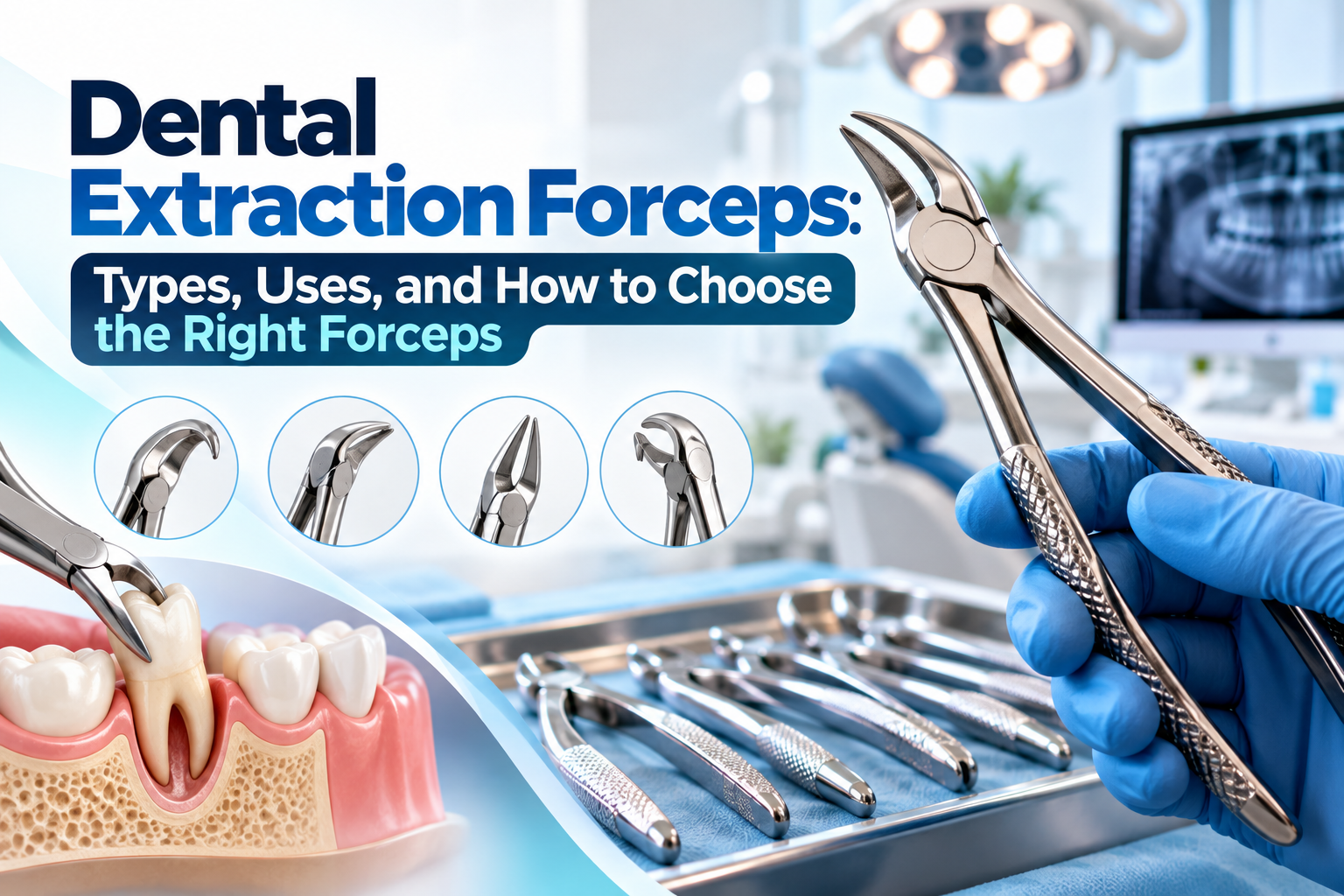
Dental extraction is not performed with a single type of instrument because teeth come in different shapes and sizes. Therefore, for each case, dentists choose dental extraction forceps to ensure the most efficient and safest manipulation. Such instruments are presented in wide varieties and variations. For example, forceps for extracting anterior teeth differ qualitatively from those for premolars or retained roots.
Another essential factor when choosing dental forceps includes the location of the tooth to be extracted. Thus, for the maxilla, as well as for the mandible, special instruments are used. The molar teeth, which are located in the upper jaw, have a shape that differs substantially from the mandibular ones, so they require more attention when selecting instruments. Left and right upper molar forceps differ in detail, which is dictated by the need to follow the anatomy of the upper molar roots.
These differences mean that selecting the appropriately shaped beaks of the forceps is a very responsible process. Particular attention must be paid to the position of the instrument and its intended use. Consequently, selecting the appropriate forceps is an essential component of instrument selection, as the beak configuration, tooth position, and intended application are all considered when selecting the correct dental extraction instruments.
What Are Dental Extraction Forceps?
Dental extraction forceps are handheld instruments used by dentists to extract teeth. These instruments allow the dentist to grasp the tooth firmly and move it in a desired direction and manner by moving the handles of the forceps. Different types of these forceps are used for different teeth depending on the situation of the tooth.
Main Parts of an Extraction Forceps
An extraction forceps consists of three primary parts, namely, handles, hinge or box joint, and beaks. The two handles provide the working surface for manipulation. They also provide a place for the dental professional to hold the instrument. The box joint is the connection between the handles and the working ends of the forceps. It permits opening and closing of the forceps.
The third part of the forceps is the beaks. The beaks are the most important component of an extraction forceps. They define the instrument’s application. They should be able to grasp the tooth at the appropriate point. The width, curvature, and shape of the forceps beak vary depending on the type of forceps pattern. The articulation of the beaks with the tooth anatomy is of significant importance in the choice of an extraction forceps because of the need for the working ends to match the tooth’s accessible outline.
Why Forceps Designs Vary
The patterns of forceps are different due to the variation in the anatomical shapes of the teeth that should be extracted. The crown size, root shape, tooth location, and accessibility play an important role in the variation of the working ends of the instruments. The posterior teeth often require different patterns in comparison to the anterior ones due to the differences in access and visibility.
The dental arch also plays a role in the variation of forceps. For example, the instruments designed for the maxilla can differ from the ones designed for the mandible. Moreover, within one category, there can be several patterns that are suited for the extraction of a particular tooth or location.
Thus, for dental clinics that require a variety of patterns for different dental extractions, a 37-piece dental extraction forceps set offers more variety in comparison to other sets.
Types of Dental Extraction Forceps
Dental extraction forceps come in various patterns and are categorized according to the type of teeth extracted and their location. The major differences include the dental arch where the instrument is used, the tooth’s position, and the working ends’ shape. Being able to differentiate these categories helps determine the suitable pattern for a particular procedure.
Maxillary Extraction Forceps
Upper anterior forceps are designed to extract teeth located at the front part of the maxillary arch, incisors, and canines. Since these teeth are usually less challenging than posterior ones, these forceps may have working ends that fit the given crown shape and location. For example, a pattern of Winter upper centrals and canines forceps is used to extract the mentioned teeth.
Upper premolar forceps are used for maxillary premolars. Their design must suit the smaller, narrower crown of these teeth, as well as provide sufficient access around the tooth. The anatomy of premolars can also differ, especially in terms of root shape, so it is important to match the pattern to the tooth being extracted.
Upper molar forceps are used for maxillary first and second molars. These teeth have a different anatomical structure due to their large crown and multiple roots. The beak design, therefore, is more specific than many anterior patterns. The left- and right-handed upper molar forceps may also differ to match the orientation of the tooth.
Upper third molar forceps are used for maxillary wisdom teeth. Given the third molars are positioned farther posteriorly, accessibility may be an important consideration when determining the instrument. A pattern specific to treating teeth in this position may be considered when using an upper molar forceps.
Upper root forceps are intended for situations where the remaining root structure needs to be engaged. The working ends are designed to engage the root access rather than the larger crown surface available through an intact tooth.
Mandibular Extraction Forceps
Lower anterior and premolar forceps are used for teeth located in the front and premolar regions of the lower jaw. Their working ends are shaped to match the generally narrower crowns and root forms of these areas.
Lower molar forceps are shaped to fit the unique crown and root forms of mandibular molars, yet their working-end configurations can still provide the necessary engagement to allow the operator to work around the tooth.
Universal lower forceps offer a more generalized pattern for selected mandibular extractions in contrast to specific patterns for one particular tooth. The carbide beaked forceps for lower first and second molars are an example of a device designed for a specific extraction purpose (lower molar).
The lower root forceps are used when the existing root surface needs to be engaged directly. Choosing a root-oriented instrument is significantly relevant when no crown is available or when it no longer supplies a desirable engagement surface.
Root Extraction Forceps
Root extraction requires a different approach, due to possible reduced structure relative to an intact tooth. The working ends must engage the remaining root, independent of the crown surface. Root forceps therefore differ from many conventional crown-gripping patterns in the intended application.
Root anatomy is variable between teeth, and the access can be influenced by the position of the retained root within the arch. For practices dealing with different extraction scenarios, upper and lower root extraction forceps provide patterns designed for engaging retained root structures.
Understanding Upper Molar Extraction Forceps
The upper molars possess anatomical characteristics that make the proper forceps selection more predictable than for other tooth types. The tooth location, shape of the crown, and root system are important factors to be evaluated during the upper molar forceps pattern choice.
Why Upper Molars Require Specialized Forceps
Maxillary first and second molars most often possess three roots, two buccal and one palatal, which are joined by a relatively large crown. Such anatomical variability should obviously be taken into account when considering extraction mechanics, since it creates a different working triangle for any forceps. The size of the crown, as well as the surface of the furcation involved, will, to some extent, determine the working end geometry suitable for this type of tooth.
The location of the tooth also plays a role in the choice of the forceps. Maxillary molars are posterior teeth, and their access and removal can sometimes be challenging inside the oral cavity. The ideal forceps should therefore provide sufficient access to the tooth while still providing a proper grip.
How Beak Design Relates to Upper Molar Anatomy
The width and shape of the beaks are critical to create enough contact with the molar with the forceps. They should appropriately match the accessible contours of the crown instead of providing a destabilizing or superficial grip.
Beak geometry can also be different according to the approach of an instrument to the tooth from the buccal and palatal sides. Hence, the configuration of the working ends plays a vital role in choosing an appropriate upper molar forceps.
General vs Tooth-Specific Molar Forceps
Upper Molar Forceps are multifunctional and can be used in various patterns. Diverse beak shapes, widths, and directions are applied to meet specific demands.
For instance, NES-382 upper molar forceps and NES-383 upper molar forceps are commonly used to extract upper molars. These instruments differ in several details, which implies that the dentist’s experience and the situation present at the moment play a significant role. The side of the tooth, its access, position, and state determine the pattern of upper molar forceps to use.
Why Left and Right Upper Molar Forceps Are Different
Left and right upper molars differ in their orientation. Due to this, the side specific forceps have an opposite working-end shape, which fits the side of the tooth being extracted.
The Importance of Side-Specific Design
The approach to the upper molar is not always the same on either side of the mouth, and the orientation of a tooth and the working space can change, depending on which side a practitioner is working on. This can be an important consideration in choosing a pair of forceps.
A side-specific tool can allow the working ends to better match the position and accessible surfaces of the tooth and more consistently seat the beaks around a crown. And so, a left-side forceps should not be considered interchangeable with a right-side pattern simply because they both target the upper molar.
Left Upper Molar Forceps vs. Right Upper Molar Forceps
Left and right upper molar forceps differ by the working end’s orientation to the tooth. Both patterns are the same, but they are aimed at lifting the tooth from different sides. For example, NES-380 Upper Molars Right is the pattern for extracting the tooth from the right side, and NES-256 Carbide Serrated 1st & 2nd Upper Molars Left and NES-257 Carbide Serrated 1st & 2nd Upper Molars Right present the left and right patterns, respectively. Thus, the side of the maxilla is significant and must be considered when selecting forceps for the procedure.
How to Choose the Right Dental Extraction Forceps
The process of choosing dental extraction forceps begins with identifying the tooth and selecting forceps that correspond to its anatomical and clinical needs. The proper pattern can make the instrument selection easier and ensure that the practitioner uses an appropriate point of engagement.
Identify the Tooth
First, it is crucial to identify the tooth that requires extraction. Since incisors, canines, premolars, molars, and third molars are different, the patterns of the forceps may also vary. If the dentist observes that only the root is left, extracting it with root forceps may be more appropriate than using pattern forceps.
Identify the Arch.
Next, determine whether the tooth is in the upper or lower jaw. The teeth in different jaws have different relations, and forceps designed for one type of jaw may not have the proper configuration for the other.
Check Whether a Side-Specific Pattern Is Needed
For certain teeth, predominantly upper molars, ascertain whether a left- or right-sided pattern is needed. Side-specific forceps are shaped according to the orientation of the tooth within the arch, and hence this is a pertinent consideration in selecting an upper molar instrument.
Consider Tooth and Root Condition
The condition of the tooth should also be assessed. For instance, we can examine how much of the crown remains, whether the tooth has a large restoration or fracture, and if the roots have a relatively simple or more complicated anatomy. Accessibility is another legitimate concern, especially for those teeth located more towards the back of the mouth.
Match the Beaks to the Intended Use
Finally, examine if the beak configuration matches the tooth and intended use. The width, shape, and orientation should provide adequate contact with available tooth structure rather than an unsuitable pattern.
In the case of a broader approach to selecting instruments, the principles involved in selecting the appropriate dental extraction tools can help when comparing various extraction instruments.
Dental Extraction Forceps vs Other Extraction Instruments
The dental extraction process can include a number of dental instruments. Forceps, elevators, luxators, and root elevators are the most commonly used tools, and each has a specific purpose. A qualified dentist should be able to choose the right instrument for each particular case and the location of the tooth that needs to be extracted.
Forceps
Dental extraction forceps are used to grasp the tooth, and they are primarily used to assist in tooth delivery after it has been loosened sufficiently. The forceps’ beaks can engage available tooth structure, while their handles give the user control over the instrument.
Elevators
Dental elevators usually play an essential role in luxating the tooth to be extracted as well as applying force to it. It is applied during the procedure or before the extraction. The tool mainly works on the principle of leverage, which requires a fulcrum, force, and resistance. Elevators can be used with forceps to extract a tooth that offers an increased resistance to removal.
Luxators
Luxators possess a narrower working end and are specially designed to enter the periodontal ligament space around the tooth. They can be used to separate teeth from the surrounding attachment before the application of forceps. Their slender working end makes their use for controlled access around the tooth particularly important.
Root Elevators
Root elevators are used in cases where a root fragment needs to be extracted or in those instances when access to the root is required. Their working ends are specially designed to engage and lift roots rather than to grasp an intact crown. Thus, different surgical instruments can be used for different stages of the procedure. A dental practice, which regularly deals with complex extractions, should consider having a variety of root elevators as well as appropriate extraction forceps on hand.
Common Mistakes When Selecting Extraction Forceps
When choosing extraction forceps, besides considering the instrument number, which describes a pattern specific to a single instrument, it should also be taken into account which tooth and purpose the instrument is needed for.
The most common mistake when choosing extraction forceps is not paying attention to the tooth location. Thus, it is wrong to choose an instrument suitable for extracting an anterior tooth for a similar-looking posterior tooth, and vice versa. In addition, maxillary and mandibular pattern forceps should not be mistaken for each other, although they are used for similar purposes.
A less obvious mistake when choosing an extraction forceps is not paying attention to the side of the dental arch. This mistake is especially relevant for forceps designed for maxillary molars where left and right patterns differ significantly, as well as for patterns with side extensions, which must be selected according to the side of the dental arch.
The most significant mistake when choosing extraction forceps is not taking into account the condition of the particular tooth to be extracted. One must consider the amount of available tooth tissue to be able to choose the instrument best suited to the task. For example, the absence of a root or a crown cannot be compensated by simply applying more pressure.
Moreover, it should be emphasized that additional pressure on the instrument is not a solution to the problem if the wrong tool has been selected. It is necessary to choose the instrument for a particular procedure and purpose based on the patient’s tooth structure.
Dental Extraction Forceps – Upper Molars Left – NES-311
Designed for Left Upper Molar Applications
The Dental Extraction Forceps – Upper Molars Left – NES-311 falls under the category of dental forceps meant for extracting upper molar teeth on the left side. As such, the side of the tooth is an essential consideration in deciding whether this pattern would be suitable for a particular procedure or not.
Where NES-311 Fits in an Extraction Instrument Set
The purpose of the NES-311 is different from general upper molar forceps because it is designed to act on the left upper molar region. This instrument should also not be mistaken for a right upper molar pattern intended for the opposite side. Lower molar forceps have a pattern for mandibular teeth, whereas root extraction forceps are for removing the root with a remaining part of the tooth instead of an intact crown.
Why Add a Left-Specific Forceps to a Dental Tray?
The availability of an upper molar forceps for the left side allows selection based on the tooth and side being treated instead of a general pattern. It also enables easier organization of the trays when different procedures have distinct extraction patterns applied.
A user who requires an instrument dedicated to the left side of the maxilla may visit the Dental Extraction Forceps – Upper Molars Left – NES-311 page to examine the product’s description and additional specifications.
Frequently Asked Questions
What are dental extraction forceps used for?
Dental extraction forceps are used to provide an operative grip during the tooth extraction process.
Which forceps are used for upper molars?
The upper molar forceps are used for maxillary molars.
How do I choose the correct dental extraction forceps?
Choose forceps based on the tooth, root anatomy, accessibility, and appropriate beak shape.
Why are dental extraction forceps of different shapes?
They are different shapes because it is helpful to get a better grip and access for certain teeth and situations.
Are dental extraction forceps made in different sizes?
Yes, they are different sizes and shapes for certain teeth and situations.
Final Thought
The choice of dental extraction forceps depends primarily on the particular tooth to be extracted, the location, side, and condition of the tooth, and the design of the instruments. For the upper molars, the forceps can be divided into left and right, meaning that for the particular side of the mouth, the pattern has to be selected accordingly. Considering the range of sizes and patterns of these instruments, it is essential to ensure the proper set for the dentist to be able to choose from the array of options according to the patient’s needs.