


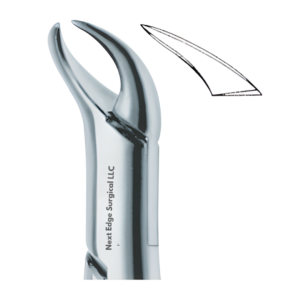


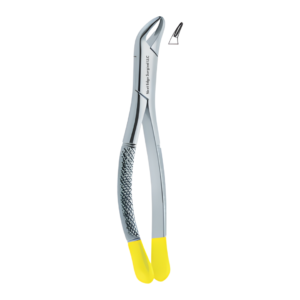
Dental Extraction Forceps – Lower Incisors Premolars – NES-337
The narrow crowns of lower incisors and the stronger posterior position of premolars create different challenges during extraction. Both groups require a clear view of the remaining tooth structure and careful control of movement within the socket.
Our Lower Incisors Premolars Forceps – NES-337 is designated for suitable mandibular incisor and premolar extractions. It brings two lower-arch tooth groups together within one stated instrument application.
Working Between the Mandibular Front and Middle Regions
Lower incisors commonly have slender, flattened roots and limited crown width. Mandibular premolars usually have a single root, although curvature and additional anatomical variations occur. These differences affect the force needed for mobilization and the direction of controlled delivery.
NES-337 forms part of our dental extraction forceps range. Its designation identifies lower incisors and premolars rather than mandibular molars. The clinician evaluates periodontal support, crown integrity, and root anatomy before selecting a suitable extraction technique.
Features and Benefits
| Feature | Benefit |
| Lower incisor application | Addresses suitable mandibular anterior tooth removal. |
| Lower premolar application | Includes teeth situated behind the lower canines. |
| Mandibular designation | Distinguishes the intended arch from upper tooth patterns. |
| Two-group clinical scope | Supports planning for distinct lower tooth categories. |
| Crown engagement function | Provides grasping during appropriate tooth delivery. |
| Extraction workflow role | Complements evaluation, mobilization, and controlled removal. |
Instrument Care and Handling
Examine the contact areas before use, checking for visible residue, wear, and damage. Confirm normal opening and closing movement. Keep NES-337 positioned securely on the tray so the working ends are protected during setup and instrument transfer.
Following extraction, remove blood, tooth particles, and adherent material promptly. Clean accessible joint spaces and surfaces that contacted the crown. Complete the established cleaning and sterilization process before the forceps returns to clinical service.
When engaging a lower incisor, consider its narrow crown and the proximity of adjacent teeth. Premolar procedures require attention to root curvature and nearby anatomical structures. A heavily restored or fractured crown can limit secure engagement in either tooth group. Reassess the approach if resistance remains significant.
Maintain visibility and protect surrounding gingiva throughout placement. Avoid uncontrolled pressure against adjacent teeth. Transport the used instrument securely to processing and return it to protected storage afterward. Periodic inspection helps identify changes in working condition and supports organized preparation for subsequent lower-arch procedures.
Product Specifications
| Specification | Details |
| Product Name | Lower Incisors Premolars |
| SKU | NES-337 |
| Brand | Next Edge Surgical LLC |
| Product Category | Dental Extracting Forceps |
| Instrument Type | Lower Incisor and Premolar Forceps |
| Anatomical Region | Mandibular Incisors and Premolars |
| Intended Application | Lower Incisor and Premolar Extraction |
Frequently Asked Questions
Which teeth are listed for NES-337?
Lower incisors and premolars.
Why are lower incisor crowns challenging?
Their narrow shape can limit the available grasping area.
Do lower premolars always have straight roots?
No, root curvature and other variations occur.
Is this designated for lower molars?
No, its listed tooth groups are incisors and premolars.
How should it be maintained?
Through cleaning, sterilization, inspection, and protected storage.
Reviews
There are no reviews yet.