


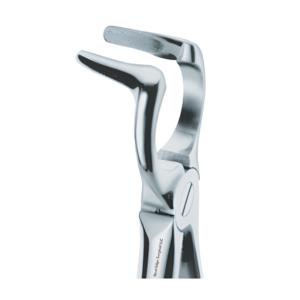
Dental Extraction Forceps – Kells Upper Incisors Canines Premolars – NES-335
When preparing an upper anterior extraction, the condition of the crown can matter as much as the tooth’s position. A restored incisor, a long-rooted canine, and a premolar with divided roots do not respond identically to removal forces.
Our Kells Upper Incisors Canines Premolars Forceps – NES-335 is designated for these maxillary tooth groups. It offers a named pattern for clinicians selecting instruments according to the planned extraction and the available tooth structure.
Evaluating Crown Support Before Forceps Engagement
Upper incisors generally have one root, while canines typically possess longer roots. Maxillary first premolars frequently have two roots; second premolars more commonly have one. Root shape, surrounding bone, and periodontal attachment influence how each tooth becomes mobile.
NES-335 is included in our dental extraction forceps range. The Kells designation identifies the pattern, and the stated tooth groups establish its intended region. A separate catalog number from another Kells instrument does not, by itself, establish a difference in working-end geometry.
Features and Benefits
| Feature | Benefit |
| Kells pattern | Identifies a named extraction forceps family. |
| Upper incisor application | Relates to suitable maxillary anterior extractions. |
| Upper canine application | Includes procedures involving long-rooted canine teeth. |
| Upper premolar application | Addresses appropriate teeth behind the canines. |
| Combined tooth-group designation | Supports preparation across several maxillary regions. |
| Forceps engagement role | Complements assessment, mobilization, and controlled delivery. |
Instrument Care and Handling
Before use, inspect the gripping areas for residue, visible wear, and surface damage. Confirm normal instrument movement and arrange NES-335 securely so heavier instruments do not strike its working ends. Review the planned tooth and its crown condition during tray preparation.
Following treatment, remove blood and adherent tooth debris promptly. Pay attention to contact surfaces and accessible joint areas, especially after extraction of a weakened crown. Complete the established cleaning and sterilization process before returning the forceps to clinical use.
During an incisor procedure, protect adjacent restorations and the supporting facial bone. For canines, consider root length and resistance. Premolar removal requires awareness of possible root separation. If movement is unexpectedly limited, reassess mobility and technique rather than increasing pressure without control.
Transfer the used instrument securely for processing. Store it in a protected upper extraction tray after reprocessing, with periodic inspection to identify changes in condition before future appointments.
Product Specifications
| Specification | Details |
| Product Name | Kells Upper Incisors Canines Premolars |
| SKU | NES-335 |
| Brand | Next Edge Surgical LLC |
| Product Category | Dental Extracting Forceps |
| Instrument Pattern | Kells |
| Anatomical Region | Maxillary Incisors, Canines and Premolars |
| Intended Application | Upper Incisor, Canine and Premolar Extraction |
Frequently Asked Questions
What teeth are named for NES-335?
Upper incisors, canines, and premolars.
Why examine crown restorations first?
They may affect the tooth’s ability to withstand engagement.
Are all upper premolar roots alike?
No, root number and configuration vary.
What does Kells identify?
The named extraction instrument pattern.
How should the forceps be stored?
Protected after cleaning, sterilization, and inspection.
Reviews
There are no reviews yet.