


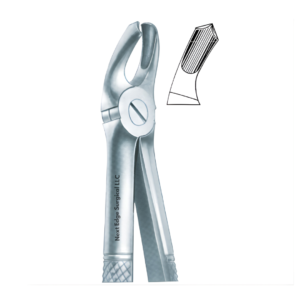

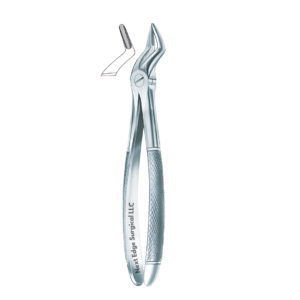
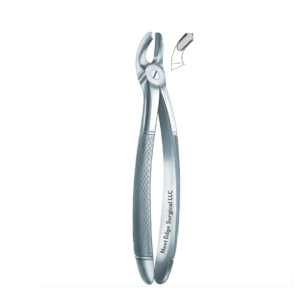
Dental Extraction Forceps – Lower Premolar Deep Gripping Root Forceps – NES-220
A lower premolar may leave behind a root segment after its crown breaks during extraction. Retrieving that segment calls for attention to how much tooth remains exposed and how firmly the root is held within the socket.
Our Lower Premolar Deep Gripping Root Forceps – NES-220 is designated for mandibular premolar root removal. Its deep-gripping description identifies a root-focused application where controlled access and suitable engagement are central to the procedure.
Assessing Remaining Root Structure in the Premolar Region
Mandibular premolars commonly have one root, but curvature, grooves, and occasional additional roots can complicate removal. The nearby mental foramen is another consideration when planning procedures around the lower premolar area.
NES-220 is part of our dental extraction forceps collection. Its designation matches that of another lower-premolar root instrument in our catalog; the separate SKU does not, by itself, establish a different working-end shape or size. Clinical suitability depends on the actual tooth and the planned technique.
Features and Benefits
| Feature | Benefit |
| Lower premolar designation | Identifies the intended mandibular tooth group. |
| Deep-gripping root application | Relates to engagement of remaining root structure. |
| Root-focused extraction role | Supports retrieval when the crown is absent or compromised. |
| Mandibular anatomical context | Encourages consideration of surrounding bone and landmarks. |
| Fragment engagement purpose | Complements appropriate root mobilization before removal. |
| Dedicated catalog designation | Helps distinguish this instrument during procedural preparation. |
Instrument Care and Handling
Before use, examine the tooth-contact areas for residue, visible damage, or irregularities. Check the instrument’s movement during tray preparation. Protect its working ends from contact with heavier tools.
After a root retrieval procedure, clear blood, adherent tissue, and small tooth particles promptly. Inspect accessible joint areas and gripping surfaces where fragments can collect. Follow the established cleaning and sterilization process before the instrument returns to clinical service.
When a lower premolar root sits below the gingival margin, assess whether direct engagement can be performed without injuring neighboring tissues. Root curvature and resistance may make additional mobilization preferable. Avoid forcing the instrument against bone or applying pressure without adequate visibility.
During transfer to processing, keep NES-220 secure and separated from heavy equipment. After reprocessing, store it in a protected root extraction tray. Regular inspection helps the team recognize changes in condition.
Product Specifications
| Specification | Details |
| Product Name | Lower Premolar Deep Gripping Root Forceps |
| SKU | NES-220 |
| Brand | Next Edge Surgical LLC |
| Product Category | Dental Extracting Forceps |
| Instrument Type | Deep Gripping Root Forceps |
| Anatomical Region | Mandibular Premolar Roots |
| Intended Application | Lower Premolar Root Extraction |
Frequently Asked Questions
What is the intended application of NES-220?
Retrieval of suitable mandibular premolar root remnants.
Why assess the root before grasping?
Curvature and remaining exposure influence the removal technique.
Is the mental foramen relevant to planning?
Yes, it is an anatomical landmark near lower premolars.
Does the SKU alone indicate a different tip design?
No, a catalog identifier does not establish physical geometry.
How should the instrument be maintained?
Clean, sterilize, inspect, and store it securely.
Reviews
There are no reviews yet.