


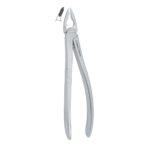


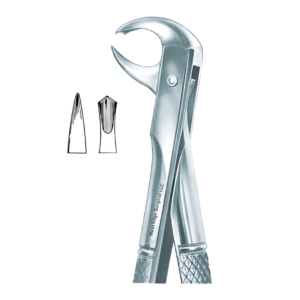
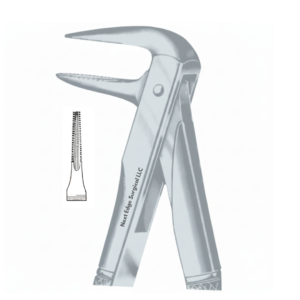


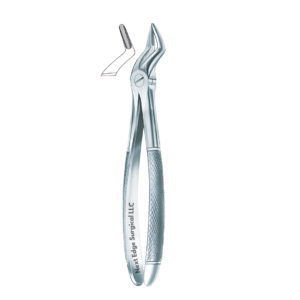
Dental Extraction Forceps – Upper Roots Deep Gripping Root Forceps – NES-218
Root removal in the upper jaw may involve a single anterior root or a fragment from a multi-rooted posterior tooth. Those situations share the need for visibility, but their anatomical risks are not identical.
Our Upper Roots Deep Gripping Root Forceps – NES-218 is designated for suitable maxillary root retrieval. The name identifies an upper-arch, deep-gripping application for clinicians preparing instruments when a remaining root requires separate attention.
Evaluating Root Position Throughout the Maxilla
The maxilla contains incisors, canines, premolars, and molars with different root arrangements. Anterior roots may lie near thin facial bone, while posterior roots can approach the maxillary sinus. Root depth, curvature, and accessibility influence the removal plan.
NES-218 belongs to our dental extraction forceps collection. Its broad upper-root designation distinguishes it from instruments named for a single maxillary tooth group. The clinician selects a suitable approach after assessing the remaining fragment, surrounding tissues, and available mobility.
Features and Benefits
| Feature | Benefit |
| Upper-root designation | Identifies an intended application within the maxillary arch. |
| Deep-gripping classification | Relates to engagement of accessible retained root structure. |
| Root retrieval purpose | Complements procedures after crown separation or fracture. |
| Cross-region maxillary focus | Supports preparation for varied upper-root locations. |
| Fragment engagement role | Provides grasping during appropriate root delivery. |
| Extraction workflow relevance | Complements examination, imaging, and preliminary mobilization. |
Instrument Care and Handling
During setup, examine the working ends under adequate light. Look for visible damage and retained particles that could affect contact. Check opening and closing movement, then position the forceps securely within the root extraction tray.
After a procedure, remove biological residue before it dries. Inspect accessible joint spaces and the surfaces that contacted the fragment. Small particles deserve attention because they can remain between contact areas. Complete the established cleaning and sterilization process before reuse.
Upper-root retrieval requires awareness of the surrounding anatomy. A root close to the sinus or a thin bony plate may demand a different strategy from an exposed anterior fragment. Maintain visibility, assess mobility, and avoid uncontrolled pressure when direct engagement is difficult.
Keep neighboring teeth and soft tissues protected throughout the procedure. Carry NES-218 securely to processing, without allowing heavier instruments to strike its working ends. Store the processed forceps in a designated protected location. Periodic inspection supports careful preparation for subsequent maxillary root procedures.
Product Specifications
| Specification | Details |
| Product Name | Upper Roots Deep Gripping Root Forceps |
| SKU | NES-218 |
| Brand | Next Edge Surgical LLC |
| Product Category | Dental Extracting Forceps |
| Instrument Type | Deep Gripping Root Forceps |
| Anatomical Region | Maxillary Roots |
| Intended Application | Upper Root Extraction |
Frequently Asked Questions
What is the intended arch for NES-218?
The upper, or maxillary, dental arch.
Does every upper root have similar anatomy?
No, root forms vary across tooth groups.
Why consider sinus proximity?
Posterior maxillary roots can lie close to the sinus.
When is direct root grasping appropriate?
When access and mobility permit controlled engagement.
How should the instrument be stored?
Protected from impacts after complete reprocessing.
Reviews
There are no reviews yet.