


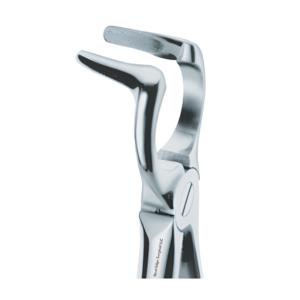
Dental Extraction Forceps – Upper Incisors and Roots – NES-293
Upper incisors occupy a prominent position in the smile, making careful tooth removal especially important when future restoration is planned. Extraction requires attention to the root, neighboring teeth, and the delicate bone surrounding the anterior socket.
Our NES-293 Upper Incisors and Roots Forceps is an American Pattern instrument for maxillary incisor extraction and appropriate root-removal procedures. Its Fig. 1 designation provides a recognizable choice for clinicians preparing an anterior extraction tray.
Anterior Tooth Access and Fig. 1 Instrument Selection
Central and lateral incisors typically have single roots, although their dimensions and curvature differ. The clinician must assess the remaining crown structure, periodontal attachment, and direction of movement before engaging the tooth.
NES-293 uses the Fig. 1 pattern, associated with upper incisor extraction. Its narrow working profile is intended for the restricted space around anterior teeth, where contact with neighboring crowns should be carefully controlled.
This instrument belongs to our dental extraction forceps collection and also serves appropriate upper-incisor root procedures. When a crown fractures, the extraction approach can shift toward engaging the accessible remaining root rather than the original crown.
Features and Benefits
| Feature | Benefit |
| Fig. 1 pattern | Provides an established upper-incisor extraction configuration. |
| American Pattern classification | Identifies the instrument within a recognized forceps family. |
| Upper incisor application | Supports procedures involving maxillary central and lateral incisors. |
| Root-removal designation | Extends its intended application to accessible incisor roots. |
| Narrow working profile | Supports positioning around closely spaced anterior teeth. |
| Anterior extraction focus | Helps organize instruments for front-tooth procedures. |
Instrument Care and Handling
Inspect the working ends before treatment, paying attention to surface condition, alignment, and accumulated debris. Check the hinge movement and examine the contact areas that engage tooth structure.
After extraction, remove biological residue promptly. Cleaning should address the beaks, accessible hinge surfaces, and any areas where deposits can remain after treatment.
Complete the established instrument-cleaning and sterilization process before further clinical use. Position the forceps carefully during transportation so other instruments do not strike the working ends.
During anterior extraction, maintain control over the direction of movement. The labial bone plate can be thin, and unnecessary pressure may compromise surrounding structures.
Assess root curvature and crown integrity before engagement. Where a root is firmly retained, additional mobilization may be preferable to increasing force.
Store NES-293 in a protected instrument tray and inspect it regularly.
Product Specifications
| Specification | Details |
| Product Name | Upper Incisors and Roots |
| SKU | NES-293 |
| Brand | Next Edge Surgical LLC |
| Instrument Category | Dental Extraction Forceps |
| Pattern | American Pattern, Fig. 1 |
| Anatomical Region | Maxillary Anterior Arch |
| Intended Application | Upper Incisor and Root Extraction |
Frequently Asked Questions
Which teeth are covered by the NES-293 designation?
Upper central and lateral incisors, including suitable remaining roots.
What is the Fig. 1 pattern?
An established forceps configuration associated with upper incisor extraction.
Can NES-293 assist after crown fracture?
Yes, when an upper incisor root remains accessible for appropriate engagement.
Why is the labial bone plate important?
Its condition influences extraction movement and preservation of surrounding anatomy.
Which areas require attention during cleaning?
The working ends, gripping surfaces, and accessible hinge areas.
Reviews
There are no reviews yet.