


Surgical Clamps Explained: Functions, Designs, and Key Differences

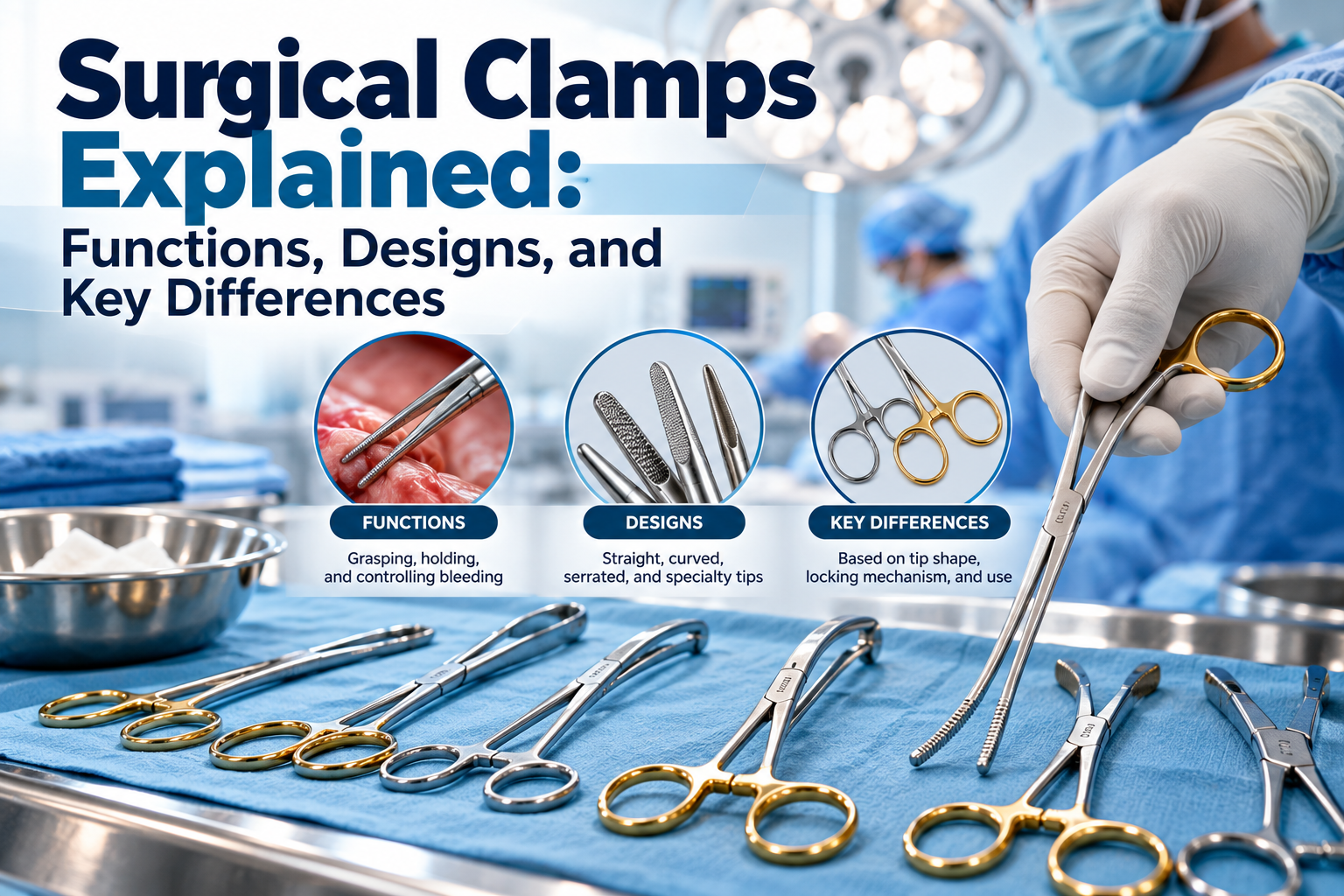
Surgical clamps are used to grasp, compress, or temporarily close a structure during surgery. They serve different purposes according to their design. Some help to stop bleeding. Others can control blood flow in vascular work, hold selected tissue, or secure surgical drapes. The word “clamp” is confusing because it has so many different functions. No one clamp will do all of these. The best clamp depends on its intended function, jaw design, size, and the structure being handled. This article will cover the basic types of clamps, detail the differences between various designs, and highlight the key factors for buyers when selecting a clamp.
What Is a Surgical Clamp?
A surgical clamp is a hand-held instrument that grips or compresses a structure. The basic components of most are two jaws, two handles, and a pivot joint. Some models feature a lock mechanism that holds the jaws in place (ratchet). Jaws may be straight or curved, and the inner surface may be smooth, serrated, or toothed according to the work.
Not all clamps are created equal. Other designs use spring action or a different mechanism. The type of instrument used depends on the shape and size of the jaw, the closing force, and intended use.
Clamps are not all about bleeding. A towel clamp is used to secure drapes and is not related to vessels. If one is familiar with the function of the clamp, it will be easier to distinguish it from similar instruments and identify the design characteristics that are important.
Surgical Clamps vs. Forceps: What Is the Difference?
The terms “clamp” and “forceps” often intersect in the terminology of surgical instruments. For example, certain hemostatic tools are referred to as hemostatic forceps, despite also functioning as clamps to manage bleeding. Both types may feature instruments with locking mechanisms, meaning that the name itself does not always indicate the instrument’s purpose.
When evaluating products from various manufacturers, it is essential to consider the intended use, jaw design, and product specifications instead of depending solely on the name.
| Feature | Common clamp designs | Common forceps designs |
| Typical function | Holding, compressing, or temporarily occluding a structure | Grasping, holding, or manipulating tissue or materials |
| Mechanism | May use a ratchet, spring action, or another mechanism | Often controlled by hand pressure; some designs lock |
| What to check | Intended function, jaw design, and pressure | Intended function, tip configuration, and grip |
It is more important to consider the intended use and design of the instrument than the label on the instrument itself.
What are the main types of surgical clamps?
Categories are subject to overlap since the terminology of clamps differs in specialties and manufacturers. The table below categorizes some common instruments by type.
| Type or category | Typical function | Examples or defining features |
| Hemostatic clamps | Temporarily compress vessels or grasp tissue to help control bleeding | Mosquito, Kelly, Crile, Rochester-Pean |
| Vascular clamps | Temporarily occlude or control blood flow in vascular procedures | Bulldog clamps and other purpose-designed vascular clamps |
| Tissue-holding instruments | Grasp or hold selected tissues | Allis and Babcock instruments, commonly classified as tissue forceps |
| Intestinal clamps | Temporarily occlude or hold sections of bowel where appropriate | Designs vary by application and tissue requirements |
| Towel clamps | Secure surgical drapes or towels | Pointed or other purpose-designed gripping tips |
| Specialty clamps | Perform one task in a particular surgical setting | Certain tubing, cardiovascular, or other specialty designs |
Hemostatic Designs
Hemostatic clamps are a common category of surgical clamping instruments. Mosquito patterns are generally the finer option. Common general-purpose hemostatic forceps are Kelly, Crile, and Rochester-Pean.
The size, jaw serration, and length vary depending on the manufacturer, so please verify each listing. There are similarities in the appearance of a fine pattern and a general-purpose pattern, but they may handle quite differently in use.
Vascular Designs
These clamps are engineered for specific applications in controlling the vessels. An example of this is the Bulldog clamps. There are differences in jaw design and closing pressure between the models.
Not all the vascular clamps fit all vessels, and the stated purpose of the specific model is more important than the name of the category.
Intestinal Clamps
These are used to temporarily close or block sections of bowel, as needed. Depending on the use and the tissue to be applied, the design is different, and the listing should indicate the purpose of the instrument.
Tissue-holding Instruments
Allis and Babcock instruments are generally referred to as tissue forceps. Buyers often see them listed alongside clamps, which is one reason the terminology confuses people. The details to compare are the tip shape and grip.
Towel Clamps
They are used to secure surgical drapes or towels. They are not meant for clamping vessels or tissue.
Specialty Designs
Clamps that have a specific application. When using an instrument, check its designated use before deciding it will be suitable for a broad purpose. Examples include specialty designs such as tubing, cardiovascular, and other designs.
How to Choose a Surgical Clamp
The selection of a clamp is a specification process and selection should be based on specifications, not the instrument’s name alone. The information provided in this guide is not intended to provide procedure-specific clinical advice. These five checks are used by professionals for comparing instruments:
- Function intended: Determine the purpose for which the instrument is used, such as hemostasis, occlusion of a vessel, tissue handling, drapes, etc. All else follows from this.
- Jaw design: Consider serrations, teeth, smooth surfaces and fenestrations with respect to the application. Never assume that any design will prevent all tissue damage.
- Length and curvature: Straight, curved, angled, and longer or shorter designs change access and handling. The right dimensions depend on the use, so confirm exact measurements in the listing.
- Material and construction: Request documentation of material and construction. Not all instruments are made of stainless steel or titanium.
- Reprocessing and documentation: Review the manufacturer’s instructions for use (IFU), compatibility with your facility’s validated reprocessing, and product documentation.
Here are some key considerations for procurement teams to make when choosing products: Check exact model specifications, intended use, dimensions, material information, and reprocessing instructions. Avoid selecting an instrument based on its name or price alone, as this can lead to mismatches.
A listing that states the intended use, dimensions, and material up front saves time and back-and-forth later to save time and reduce back-and-forth later. There is no standard best clamp. The correct selection is made according to the stated purpose.
Inspection, Cleaning, and Sterilization
Surgical instruments that are to be reused must be reprocessed between uses. According to the FDA, there is a general sequence: point-of-use processing, cleaning, then disinfecting or sterilizing (as appropriate for the device’s intended use).
The WHO offers similar facility-level principles for decontamination and reprocessing, with the steps carried out in sequence.
Before reuse, inspect an instrument:
- Examine the jaws for any signs of damage, misalignment, corrosion or wear.
- Check locks and moving components to ensure they operate smoothly and remain secure.
- Clean, disinfect, sterilize, and handle according to the manufacturer’s instructions.
- Verify if the technique is appropriate for the model and its materials.
Do not assume every reusable clamp can go through the same cycle. Requirements may differ by model and material. Temperatures, times and chemicals need to be taken from the validated instructions and your facility’s procedures.
The FDA also notes that device design and the quality of reprocessing instructions affect how well an instrument can be cleaned.
Common Mistakes When Evaluating Surgical Clamps
Three errors come up often:
- Choosing by a familiar name without checking the exact design and intended use.
- Assuming all clamps share the same jaw pressure, material, size, or locking mechanism.
- Buying reusable instruments without reading their documentation and reprocessing requirements.
Specifications that are clearly defined ensure that buyers can make comparisons of like with like and eliminate unnecessary purchase mismatches. They also help to facilitate agreement between clinical and purchasing personnel on what is really required.
What Should Buyers Check When Comparing Suppliers?
There are many differences between product pages in what they tell you. Check for a simple-to-understand product description, accurate dimensions, material details, usage information, documentation information, and easy-to-understand ordering or quotation information.
One supplier to look at when inspecting surgical instruments is Next Edge Surgical LLC. Before you assume you’ll be able to find a model, you need the details above, so ask for a quotation if you need things that are not listed.
Conclusions: Knowledge of surgical clamp designs
Surgical clamps vary in function, jaw shape, size, and mechanism. Given these differences, a buyer should consider buying instruments more carefully and determining the specifications to verify.
Select an instrument according to its documented purpose and requirements. When the answers are clear, it results in better buying decisions.No single clamp type is better than the rest. The best fit is the one that matches the described task.
Frequently Asked Questions
They handle specific tasks: temporarily compressing vessels, holding selected structures, or securing surgical drapes. The function of a clamp is dependent upon the design and purpose of the clamp.
Hemostatic clamps are frequently used to compress vessels to help control bleeding. Vessel clamps are available for specific vessel occlusion or blood-flow-control requirements. The exact functions and design details are dependent on the model.
Not exactly, but there is some overlap. There are a number of hemostatic instruments that are referred to as forceps and some tissue-grasping instruments lock. Intended use, jaw design, and the manufacturer's description help distinguish individual instruments.
Use and reprocess according to the manufacturer's recommendations and validated reprocessing procedures in your facility. Generally, reusable instruments require initial processing, cleaning, and then disinfection or sterilization appropriate for the use.