


Liston Knife: Uses, Sizes, History, and Specifications

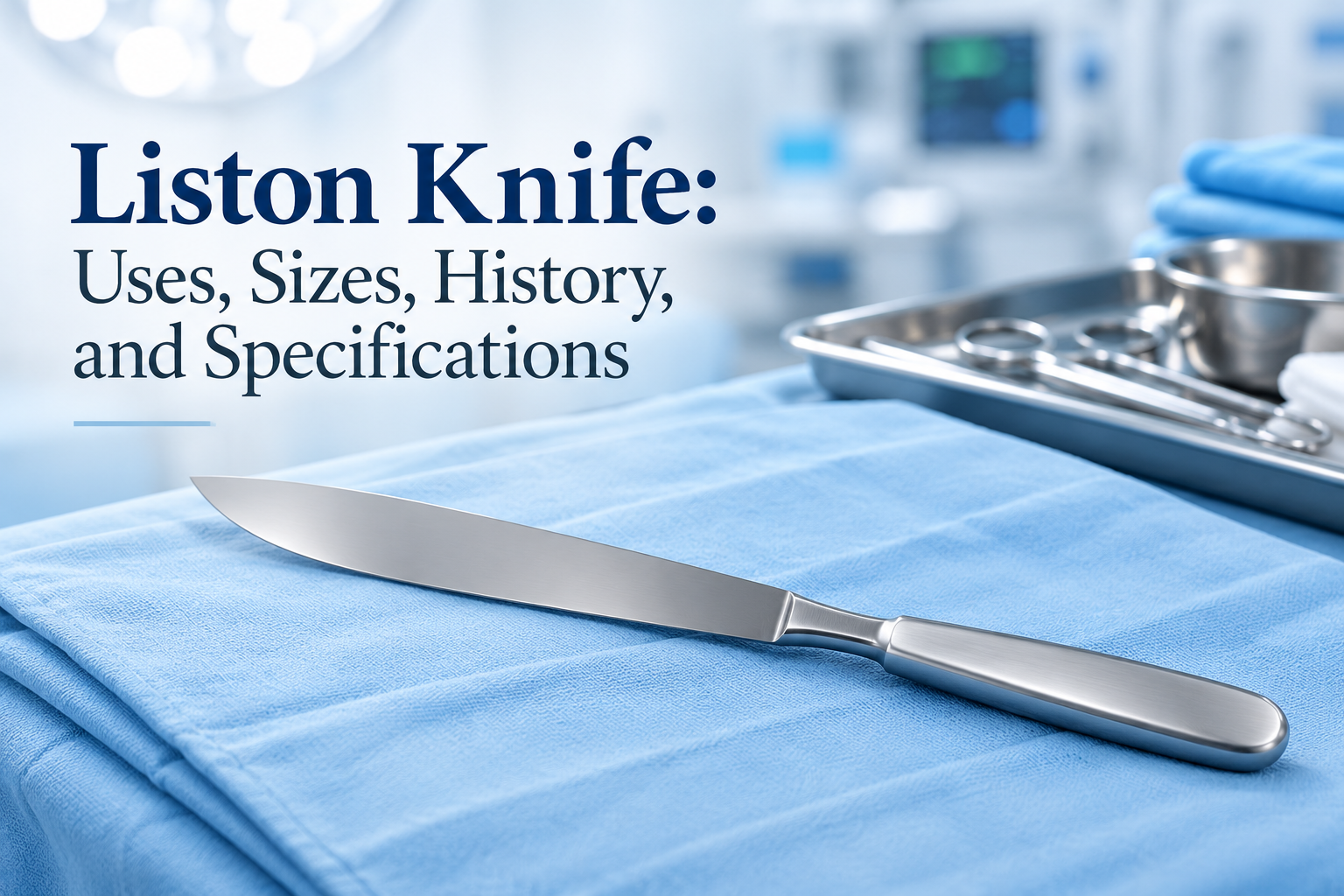
A Liston knife is a long-bladed surgical knife historically associated with amputation. It is named after Robert Liston, a Scottish surgeon known for his speed before anesthesia. Museums hold many historical examples, and modern Liston-type instruments still appear in manufacturer and supplier catalogs.
That does not mean every listing describes the same knife. Dimensions, handles, materials, and labeling differ by model. This guide explains what a Liston knife is, why it has that name, how historical and modern versions differ, and what to check before you compare products.
What Is a Liston Knife?
A Liston knife is a long-bladed surgical knife historically used in amputation. The Smithsonian’s National Museum of American History describes a typical Liston knife as having a long, thin blade. The name refers to Robert Liston, but it describes a type of instrument, not one fixed design.
Historical examples vary in size. Wikipedia gives a typical blade length of 6 to 8 inches. Albuquerque Museum records list Liston knives from 1863–65 at roughly 30 to 38 cm overall. Modern catalogs add their own sizes on top of that.
In short, Liston knives exist in different designs and dimensions, across both historical examples and modern manufacturer catalogs. Here is the basic anatomy:
| Part | What it refers to |
| Blade | The cutting portion of the instrument |
| Cutting edge | The sharpened portion intended for cutting |
| Heel/Tang | The area connecting the blade to the handle |
| Handle | The portion used to hold and control the instrument |
What Is a Liston Knife Used For?
Historically, a Liston knife was used for amputation. The Albuquerque Museum notes that these knives cut muscle during amputations and were kept sharp and clean. The Smithsonian’s example belonged to an amputation set of sixty instruments carried by a Union Army surgeon during the Civil War. A Canadian museum record describes the knife as a tool for cutting through soft tissue to expose the long bones of the leg, thigh, or upper arm.
Modern catalogs describe applications differently. One manufacturer’s catalog files its Liston amputation knife under general surgical instruments. It lists orthopaedics and traumatology, general and visceral surgery, and vascular surgery as disciplines. One supplier listing names general surgery and autopsy as the specialty for its version.
Keep one point in mind. A current product listing shows what a manufacturer offers. It does not show how often surgeons use the instrument today. This article does not cover surgical technique. Clinical use belongs to trained surgeons working under their facility’s protocols.
Why Is It Called a Liston Knife?
The name comes from Robert Liston (1794–1847), a Scottish surgeon. The Smithsonian notes his skill and speed in an era before anesthetics, when speed mattered for pain and survival. According to the American College of Surgeons, he performed an operation using ether on December 21, 1846. A peer-reviewed historical note reports that at least one of his amputations took under 30 seconds.
Wikipedia adds a useful caution. The dedicated task of amputation may be more responsible for the “Liston” title than any specific blade design, and the American Civil War likely shaped the long, slender style more than Liston himself.
You may also see the claim that Liston had a “300% mortality” case. It is widely repeated, but MDLinx calls it apocryphal, and the Medical Independent asks whether it is fact or fiction. Treat it as a story, not a statistic.
Historical Liston Knives vs. Modern Liston-Type Knives
Historical examples differ even from one another. The Smithsonian’s knife was made by Jacob Gemrig of Philadelphia in the 1850s or 1860s. It is steel with an ebony handle and measures about 12.5 inches overall. The Royal College of Physicians and Surgeons of Glasgow holds an 1860s knife of metal and ebony, 32 cm long. Royal Museums Greenwich catalogs a Liston knife that belonged to David Livingstone as a double-edged amputation knife, 335 mm overall.
Modern examples come from manufacturer and supplier catalogs. Supplier listings, for instance, describe stainless steel, reusable, non-sterile knives. Those details come from product labeling, not from history.
So “Liston knife” does not describe one identical design across every historical and modern example. A modern stainless-steel Liston-type instrument should not be treated as identical to an original instrument associated with Robert Liston.
Age and wear matter as well. The Smithsonian notes that surgeons often replaced broken or lost instruments, so historical sets mixed pieces from different makers. A single museum knife may not match the rest of its set.
Liston Knife Design and Main Features
Blade. Sources describe a long blade. A historical note in the medical literature says Liston’s amputation knives had straight blades, unlike the curved knives used in circular amputation. Wikipedia reports that blades grew straighter by 1870. The blade’s cutting length differs by model.
Handle. Historical examples often pair steel with ebony. Modern listings show other configurations. One manufacturer lists a hollow handle, and at least one supplier listing describes a flat handle. No source here shows that one handle style is better than another.
Construction. Some modern models state stainless steel and reusable construction. Check each manufacturer’s wording for the exact model.
| Feature | What to look for |
| Blade profile | Straight or other documented configuration |
| Blade length | Confirm exactly what dimension is being provided |
| Overall length | Full instrument measurement |
| Handle | Flat, hollow, or other documented configuration |
| Material | The manufacturer’s stated material |
| Reusable status | Manufacturer labeling |
| Sterile status | Supplied sterile or non-sterile |
| Documentation | IFU and manufacturer specifications |
These features belong to specific models. They are not universal Liston knife traits.
Liston Knife Sizes and Specifications
Blade length and overall instrument length are not always the same measurement. This matters when you compare suppliers, because one listing may give blade length and another may give total length.
Published listings show how much dimensions vary:
Two U.S. supplier listings show 6¾-inch and 8-inch versions, and 17 cm and 20 cm versions.
One manufacturer lists a Liston-style knife with a 190 mm cutting length, 32 cm overall, a hollow handle, and a weight of 0.312 kg.
Another manufacturer lists a model at 14″ overall with a 220 mm blade length.
Royal Museums Greenwich lists a historical Livingstone knife at 335 mm overall.
These figures belong to the models named. They are not universal sizes. The Canadian museum record also notes that Liston advocated instruments sized in proportion to the specific amputation, which is one reason historical dimensions differ.
Published listings show different dimensions by model and manufacturer, and measurements are not always described the same way. Confirm whether a listed figure refers to blade length, cutting length, or overall length.
| Specification | Why it matters |
| Blade/cutting length | Identifies the actual cutting dimension |
| Overall length | Shows the full instrument size |
| Material | Confirms what the manufacturer specifies |
| Handle configuration | Helps distinguish models |
| Weight | Adds product information |
| Reusable/non-sterile status | Important for processing |
| Manufacturer/model number | Verifies the exact instrument |
| IFU | Gives manufacturer-specific instructions |
Liston Knife vs. Catlin Knife and Other Amputation Knives
These instrument names are related historically, but they are not interchangeable.
| Instrument | General design/context | Key distinction |
| Liston knife | Long surgical/amputation knife | Associated with Liston and amputation |
| Catlin knife | Historical amputation knife | Different historical design/context |
| Amputation saw | Saw rather than knife | A different instrument category |
| Scalpel | Smaller surgical cutting instrument | More broadly associated with surgical incisions |
The same medical-history note says Liston used a Catlin knife to cut leg muscle flaps in preparation for amputation. That shows the two knives had different roles in the same period.
You may find sources that separate the two by single or double edge. This guide does not rely on that rule. The Greenwich collection catalogs a Liston knife as double-edged, so edge count alone is a weak way to tell the names apart. When you see either name on a listing, read the specifications for the exact model.
Materials, Handles, and Manufacturing Quality
Focus on what you can verify, not on general quality claims.
Check the exact material and grade the manufacturer states. Some listings name stainless steel. Others add claims such as “German stainless steel.” Treat that as a product-specific claim, not a feature of every Liston knife.
Look at handle construction, surface finish where documented, and the manufacturer’s model number. Documentation and traceability matter too. One manufacturer, for example, states that its listing has UDI direct marking.
Avoid words like “premium” or “ultra-sharp” unless the manufacturer or another reliable source backs them up. Marketing adjectives are not evidence of quality.
If a listing is vague, ask the supplier for the manufacturer’s material statement. A line such as “stainless steel” leaves out the grade. Match the statement to the model number, so you know it covers the instrument you are buying and not a similar one. Historical pieces differ too: museum records describe steel blades with ebony handles, while one laboratory supplier describes a one-piece stainless-steel design.
Are Liston Knives Reusable and Supplied Sterile?
Are Liston knives reusable? Some modern models are labeled reusable. Two manufacturers and one supplier state it for their listed models. Reusable status is manufacturer-specific. It does not tell you whether an instrument arrives sterile.
Are Liston knives supplied sterile? The same listings describe their knives as non-sterile. A reusable instrument may be supplied non-sterile, and non-sterile does not mean disposable. Check the labeling and documentation for the exact model.
Two rules help:
- Reusable does not mean sterile
- Non-sterile does not mean disposable
Procurement teams should confirm both points before ordering.
The distinction matters in practice. A knife supplied non-sterile has to go through your facility’s processing before sterile clinical use, according to its labeling. A knife labeled reusable still needs cleaning, inspection, and processing between uses under the IFU.
Labeling can differ between models from the same supplier, so read each product page, not the category description.
Cleaning, Sterilization, and Care Considerations
This section is general education. It does not replace the manufacturer’s instructions for use (IFU) or your facility’s validated sterile-processing procedures.
The usual sequence looks like this:
- Follow the manufacturer’s IFU for the exact model.
- Clean the instrument as instructed. CDC guidelines stress that disinfection and sterilization work best after cleaning removes organic and inorganic material.
- Inspect for contamination, damage, or corrosion.
- Prepare and package it under your facility’s procedures.
- Use an appropriate sterilization process if the instrument is intended for sterile clinical use.
- Store processed instruments appropriately.
This guide gives no universal temperature, pressure, exposure time, or autoclave cycle. Validated parameters depend on the instrument, packaging, sterilizer, and manufacturer’s instructions. A 2025 multisociety guidance document from SHEA and partner organizations also addresses manufacturers’ instructions for use and tracking of reusable devices.
It also covers point-of-use treatment before sterilization, preparation of reusable devices at the processing location, and monitoring for processing effectiveness. A Liston knife is a cutting instrument, so follow your facility’s sharps-safety policy at every step.
How to Choose a Liston Knife
Work through this checklist:
- Identify the intended use: Decide whether the purchase is for clinical, educational, historical, or other purposes.
- Verify dimensions: Confirm blade or cutting length and overall length separately.
- Check the material: Use the manufacturer’s stated material.
- Check the handle: Confirm the exact handle style.
- Confirm reusable and sterile status: Do not assume either one.
- Review documentation: Look for the IFU, specifications, model number, and traceability information.
- Evaluate the supplier: Consider documentation, support, purchasing requirements, and policies.
- Verify the exact model: Similar-looking instruments can have different specifications.
Before you buy, ask the supplier to put the key details in writing: model number, which length is measured, the material statement, and sterile status. Keep a copy of the IFU with your purchase record so staff can find it later.
Training and Educational Models vs. Clinical-Use Instruments
Some products carry a training label. One laboratory supplier lists an 8-inch Liston amputating knife as intended for training and educational use only, not for human or animal procedures.
A training label is not the same as suitability for clinical use. Check the intended-use statement, labeling, and manufacturer documentation. Price alone should not decide suitability. If a listing does not state intended use, ask the supplier to confirm it.
Do not assume that a knife sold for display, teaching, or collection is meant for clinical use, and do not assume the reverse. Prices on listings change, so any figure you see belongs to that listing on that day, not to the market.
Where to Source a Liston Knife
A good supplier gives clear specifications, a model or SKU number, material information, and reusable or non-sterile status. It should also provide documentation, B2B purchasing support, and answers to specification questions.
Next Edge Surgical LLC is a Salt Lake City, Utah supplier of dental and surgical instruments, with B2B supply services. Procurement teams can use the checklist above when they ask any supplier about a specific model.
Two questions are worth asking every supplier. Can you confirm both blade length and overall length for this model? Can you share the manufacturer’s IFU on request? Clear answers show how well documented a product is.
A Liston knife is a long-bladed amputation knife named after Robert Liston. Its history is well documented in museums, but the “Liston knife” covers many designs and sizes. That is why specifications vary and why you should confirm blade length, overall length, material, handle, reusable status, and sterile status for each model.
If you are sourcing instruments for a facility, you can review the surgical instruments at Next Edge Surgical LLC and ask about product details for a specific item.
Frequently Asked Questions
What is a Liston knife used for?
A Liston knife was historically used for amputation. Museum records describe it cutting through soft tissue. Modern catalogs list it under general surgical instruments for several disciplines.
Why is it called a Liston knife?
It is named after Robert Liston, a Scottish surgeon known for his speed before anesthesia. The amputation task may have shaped the name as much as any single design.
What sizes are Liston knives available in?
Sizes vary by model and manufacturer. Listings include 17 cm and 20 cm versions, among others. Confirm whether a figure means blade length or overall length.
What is the difference between blade length and overall length?
Blade length measures the cutting portion. Overall length measures the whole instrument, handle included.
Are Liston knives reusable?
Some modern models are labeled reusable. Check the manufacturer’s documentation for your model.
Are Liston knives supplied sterile?
Some reusable models are supplied non-sterile and need processing under the manufacturer’s IFU. Sterile supply status is separate from reusable status.
Are Liston knives still used today?
Modern Liston-type instruments still appear in surgical-instrument catalogs. Catalog availability alone does not show how often they are used in clinical practice.