

Medical Coding Services
Coding that matches the medical record.
Medical coding services turn documented diagnoses, procedures, and services into standard codes. A coding review checks that those codes fit the record and the guidelines. Talk to our team about your needs.
Our Approach to Ensuring Compliance with Accurate Coding
Medical coding is more than picking a code. The code has to match what the record says about the diagnosis, procedure, or service. It also has to follow the guidelines that apply. Next Edge Surgical LLC approaches review in two steps.
First, we compare codes with the clinical documentation. Then we flag inconsistencies and mark anything that needs correction or clarification.
Each finding ties back to a specific record, so the next step is clear. The sections below show what a coding review covers.
Ensure Accurate and Complete Medical Coding
Accuracy starts with matching codes to what was documented. ICD-10 codes describe diagnoses. CPT and HCPCS codes describe procedures, services, and supplies. Each code should follow the official guidelines, such as the CMS ICD-10 resources and the HCPCS code set.
A review also checks completeness. Is every documented service coded? Are modifiers applied where they are needed? Diagnosis codes should support the procedures billed. Catching gaps early means fewer corrections later.
For surgical and procedure-based services, the details matter. The code must name the procedure that was actually performed, not a nearby one. Modifier use and code order can change how a claim is read.


Verify That Documentation Supports the Coded Services
A code is only as strong as the record behind it. Reviewers look for missing or unclear notes and for details that conflict with the selected codes. When a question comes up, it is flagged for clarification instead of settled by assumption.
Common gaps include a missing procedure note, an unsigned entry, or a diagnosis that is mentioned but never explained. Clear records also give coders what they need without guessing. This matters at scale.
CMS reported a 6.55% improper payment rate for Medicare fee-for-service in fiscal year 2025, about $28.83 billion. CMS says insufficient documentation is a leading cause and that it is generally not a sign of fraud.
Check for Upcoding or Downcoding
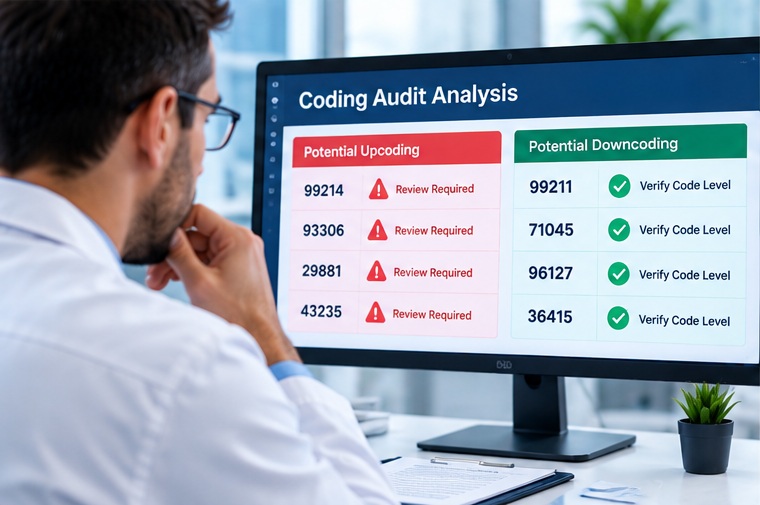
Two mismatches draw the most attention in coding review. Upcoding means assigning a code for a higher level or more extensive service than the documentation supports. Downcoding means assigning a lower-level code when the documentation and guidelines may support a different level.
Both call for review, because coding should reflect the service that was documented. Any correction must rest on the medical record and the coding rules.
The goal is supported coding, not higher or lower reimbursement. Reviewers compare the code level with the note, the guideline, and the service described, one record at a time.

Achieve Accurate Billing with Detailed Coding Audits
A coding audit looks at the work after the codes are assigned. A reviewer takes a sample of records, compares each code with the documentation, and looks for repeated patterns. Findings are then sorted into what needs correction, clarification, or further review.
The sample can be small, such as one provider or one service line. Routine coding handles one encounter at a time. An audit steps back and shows where issues repeat.
Errors do occur at scale. One study of Medicare claims for knee and hip replacement patients found about 9% of discharge destination codes inaccurate.
Why Detailed Coding Audits Matter
A coding audit can bring out issues that routine claim processing may not show. Some are coding errors. Others sit in the documentation. Looking at both together shows teams where to start. It is not a one-time cleanup. Done on a regular schedule, it also shows whether earlier fixes worked.
Ensure Compliance
Check coding practices against applicable guidelines to flag possible compliance concerns for further review.
Support Appropriate Reimbursement
Supported code assignment can reveal possible undercoding or payment discrepancies worth a closer look.
Improve Documentation
Repeated gaps can point to a need for clearer records or better coder and clinician communication.
Identify Errors
Comparing codes with medical records can surface discrepancies that need correction.
Enhance Efficiency
Spotting recurring issues helps teams prioritize fixes and cut avoidable rework.
Advantages of an External Medical Coding Audit
An external audit gives an additional review perspective on coding and documentation. Depending on the scope, findings may help an organization spot recurring discrepancies, review potential compliance concerns, and decide where more investigation or staff education may help.
An outside reviewer is not tied to daily workflow, which can make patterns easier to see. The team agrees on scope, sample size, and findings before the work begins.
Identify Coding Errors
Reviewing selected records can reveal where code assignment and documentation do not agree.
Address Documentation Shortcomings
Recurring gaps can be flagged for clarification or documentation improvement.
Discover Reimbursement Opportunities
An audit can flag coding discrepancies that warrant further review for appropriate reimbursement.
Review Compliance Practices
Examining coding practices against relevant requirements shows where more attention is needed. It does not guarantee compliance.
Improve Coding Process Efficiency
Repeated issues may point to review steps that can be tightened to reduce rework.
Identify Staff Training Needs
Repeated error patterns can show which coding topics call for added education.

What Insights Can a Medical Coding Audit Reveal?
An audit can show more than isolated mistakes. Depending on its scope, findings may include repeated coding discrepancies, documentation gaps, and possible modifier issues. If denials are part of the review, coding-related denial patterns may appear too.
Reviewers may also note possible undercoding or higher-level codes the record does not support. Consider audits when denials rise, a backlog builds, new providers join, or payer rules change.
A UK audit of 8,888 emergency medical discharges found at least one change to the original coding in 55% of admissions. Findings are only as broad as the records reviewed, so scope matters. Each finding points to an area for follow-up or staff education.
Use these findings to prioritize corrections, staff education and process improvements.
FREQUENTLY ASKED QUESTIONS
Medical Coding FAQs
Medical coding services turn documented diagnoses, procedures, and services into standard codes such as ICD-10-CM, CPT, and HCPCS. A service can cover code assignment, documentation review, or an audit of codes already assigned. It does not replace clinical judgment or the provider’s documentation.
Coding assigns codes based on the medical record. Billing uses those codes to submit claims and follow up on payment. The two work closely, but they are separate steps. Errors in the first step often show up as denials or corrections in the second, which is why many organizations review both together.
It compares assigned codes with the medical record and the applicable guidelines. Reviewers look for unsupported codes, missing documentation, modifier problems, and repeated patterns across records. The result is a list of findings sorted by what needs correction, clarification, or further review.
Published studies report a wide range. Results depend on the setting, the type of code, and how accuracy is measured. That is why a sample review of your own records is more useful than a national average.
Talk to Next Edge Surgical About Your Coding Needs
Coding needs differ by the services provided, the documentation on hand, and the problems an organization wants to solve. Knowing these details is the first step in setting the scope of a review.
Contact Next Edge Surgical LLC to talk through your requirements. It helps to share the concern behind your request, the type of records involved, and your specialty. A short conversation can show whether the service is a fit. We will go through next steps with you.