


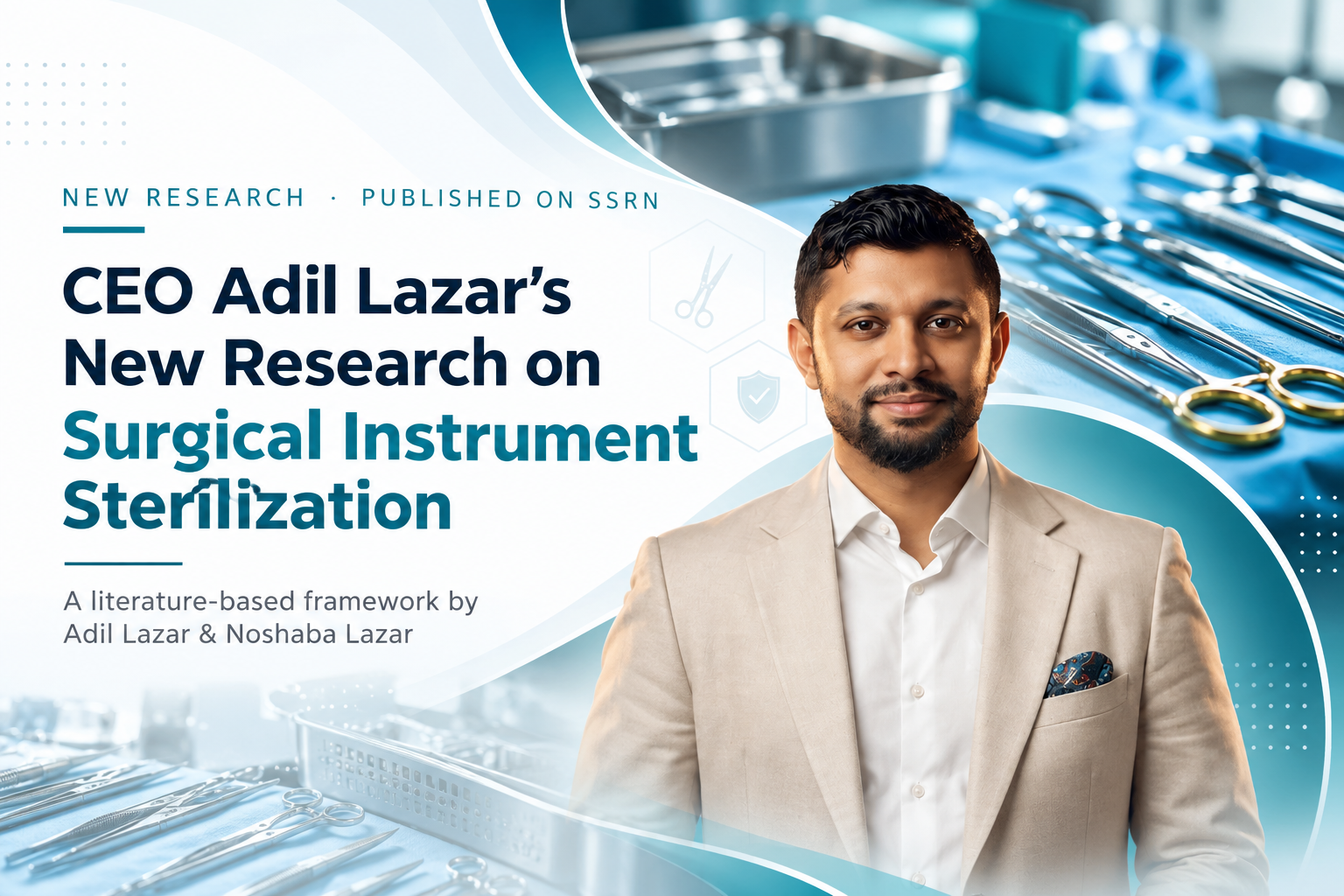
CEO Adil Lazar’s New Research on Surgical Instrument Sterilization

Every sterile processing department knows the routine. Instruments return from surgery. They clean, inspect, pack, and send them through the autoclave. Then it all happens again and again. After enough rounds, someone looks at an instrument and asks the question nobody has a clean answer to: is this one still good? So, this is all about surgical instrument sterilization.
A new research paper co-authored by our CEO, Adil Lazar, takes that question seriously. Published on SSRN this week, the study pulls together published evidence on what repeated steam sterilization does to reusable surgical instruments and proposes a practical framework for judging instrument quality across their full working life.
It matters more than most people realize. An instrument that looks fine but has a compromised edge or hidden surface damage isn’t just a replacement cost. It’s a clinical risk. And right now, most facilities are making that call with surprisingly little to go on.
The Problem with Counting Cycles
Walk into most hospitals, and you’ll find some version of the same rule: after a set number of autoclave cycles, the instrument gets retired. It’s simple, it’s trackable, and it feels objective.
The problem is that a cycle count, on its own, doesn’t say much about the actual condition of an instrument. Two forceps with identical cycle counts can be in completely different shape. One might have been processed with clean steam, proper drying, and careful handling. The other might have spent years in harsh cleaning chemistry, hard water, and rushed drying. Same number. Very different instruments.
The research makes this point directly: the total number of autoclave cycles should not be treated as a stand-alone indicator of quality or as an automatic trigger for retirement.
What the Study Actually Looked At
This is a literature-based study, meaning the authors collated and analyzed published evidence rather than running new lab tests. The paper covers the full reprocessing journey: clinical use, cleaning, inspection, packaging, steam sterilization, handling, and maintenance.
From that evidence, it builds a quality-assessment framework organized around three areas:
- Structural integrity: The physical condition of the instrument, including pitting, edge changes, surface deterioration, and other wear that accumulates across repeated processing. Published microscopy studies confirm these effects are real, though they vary widely by instrument and protocol.
- Function-specific performance: An instrument isn’t just a piece of steel; it’s a tool with a job. Scissors need to cut cleanly, forceps need to grip, clamps need to hold. The framework asks whether the instrument still performs its specific function to standard.
- Documented reprocessing history: The paper trail: how many cycles, what cleaning chemistry, what water quality, what maintenance. Without it, you’re guessing. With it, you can make informed calls about individual instruments instead of applying blanket rules.
What Damages Instruments isn’t just the Autoclave
One of the most useful parts of the study is how it widens the lens beyond sterilization itself. Steam gets the attention, but the research points to a whole set of factors that shape how an instrument ages:
Material Grade
Not all stainless steel is equal. The grade and quality of the steel decide how well an instrument resists corrosion and wear over hundreds of cycles. This is where buying decisions made years ago keep showing up.
Instrument Design
Hinges, box locks, serrations, and fine edges all create spots where stress, moisture, and residue concentrate.
Cleaning Chemistry
Aggressive detergents and wrong concentrations can attack surfaces long before the autoclave ever runs.
Water quality
Hard water and mineral-heavy steam leave deposits that drive staining and corrosion. One of the most underestimated factors in instrument lifespan.
Drying
Residual moisture after sterilization invites corrosion, especially in hinged and box-lock instruments.
Mechanical use and handling
How instruments are used, transported, and stored between procedures adds up over time.
What this means for buyers and sterile processing teams
Research is only useful if it changes what you do on Monday morning. Here’s the practical version:
- Inspect on a schedule, not just when something looks wrong. Edge condition, joint action, surface staining catch it early.
- Stop retiring on cycle count alone. Use the count as one data point alongside inspection results and reprocessing history.
- Keep real records. A simple log of use, cleaning, inspection, and sterilization per instrument or set turns guesswork into decisions.
- Audit your water and drying. Seeing staining or premature corrosion? Water quality and residual moisture are the first suspects.
- Buy for the long run. Material grade and build quality decide how an instrument handles its 200th cycle, not just its first. The cheapest instrument is rarely the cheapest over its lifetime.
For distributors and purchasing teams, the same logic applies at scale: instrument lifespan is a systems question, not a single-number spec.
About the study
“Repeated Autoclave Reprocessing of Reusable Surgical Instruments: A Literature-Based Framework for Assessing Structural Integrity and Functional Performance” is a literature-based conceptual study. It collates published evidence on reprocessing, corrosion, surface deterioration, residual contamination, inspection, and performance, and develops a quality-assessment framework. It involves Next Edge Surgical LLS instrument categories as a case application for future empirical testing.
To be clear about scope: no laboratory testing of Next Edge Surgical instruments was performed as part of this study, and no product-specific durability results are reported. The value here is the framework: a structured, evidence-backed way to think about instrument quality over time.
At Next Edge Surgical, we build reusable instruments meant to survive real-world reprocessing, with proper material grades, designs that hold up under repeated sterilization, and quality checks before anything ships. This research reflects how we think about our products: not just how they perform on day one, but how they hold up on day one thousand.
Citation
Lazar, Adil and Lazar, Noshaba, “Repeated Autoclave Reprocessing of Reusable Surgical Instruments: A Literature-Based Framework for Assessing Structural Integrity and Functional Performance” (September 28, 2026). Available at SSRN: https://ssrn.com/abstract=7535039 · DOI: 10.2139/ssrn.7535039