


Fundamentals of Periodontal Instrumentation in Modern Dental Practice

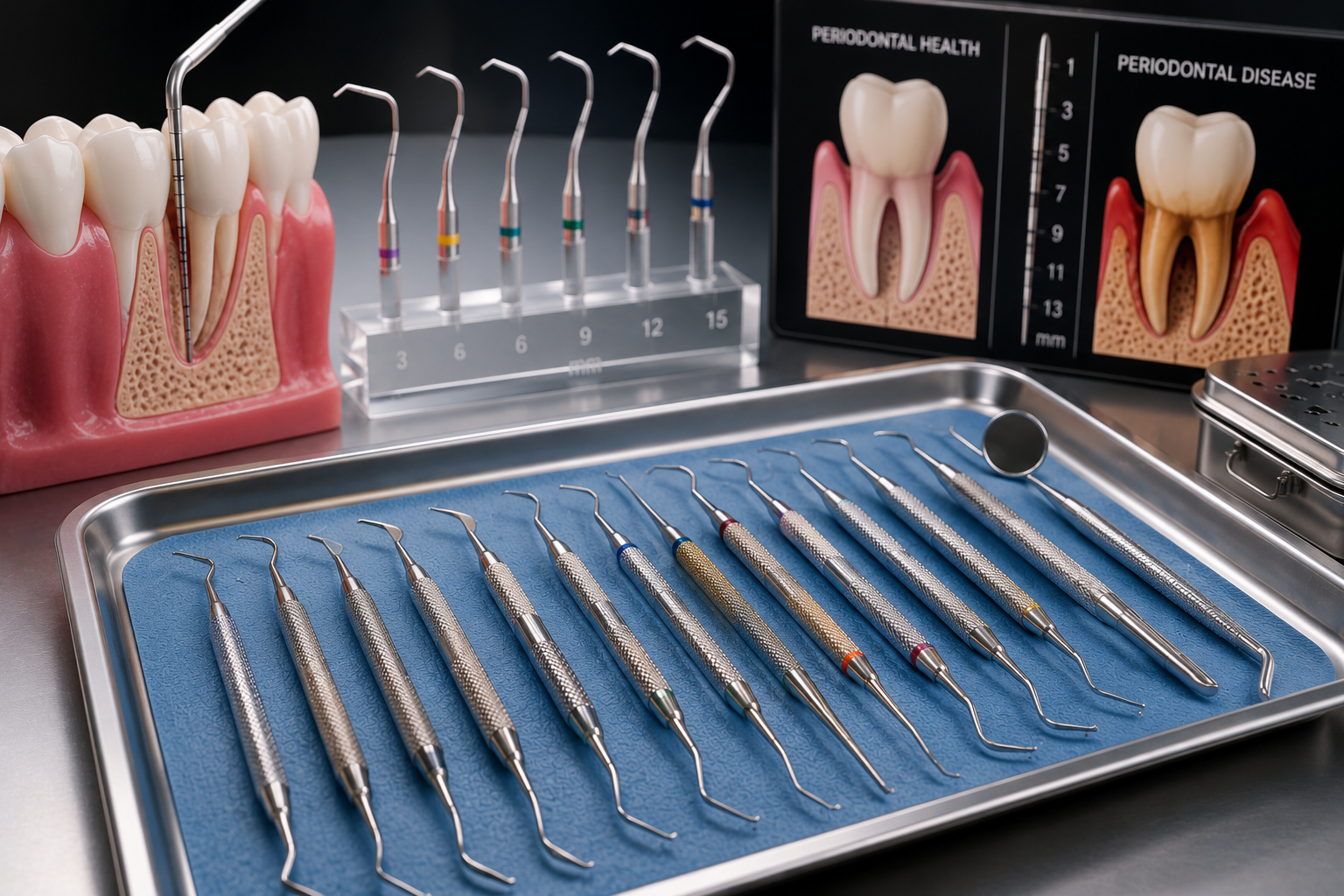
Every day, millions of people are silently losing their gum health, with most not realizing it until it is too late. That is the problem with gum disease; it’s not always a painful condition. The good news is that, with proper, timely clinical intervention and a correct approach, the disease can be prevented and tissue repaired.
Here is where periodontal instrumentation is important. A clinician’s tools and how they utilize them directly affect the patient’s experience and recovery. Accuracy is crucial in periodontal treatment, as even slight errors in instrumentation can harm soft tissue and root surfaces.
We’ll be discussing the basic instrument types, what it really means to have a good technique and the difference between a good instrument and a bad one, as well as how to maintain instrument performance over time.
What Is Periodontal Instrumentation?
Periodontal instrumentation is the clinical application of specialized instruments to diagnose, evaluate and treat periodontal disease. The two most common methods are scaling (plaque and calculus are removed from the surfaces of the teeth) and root planing (the root surfaces are smoothed so that the tissue reattaches and heals).
These procedures are performed both above and below the gumline. The fundamentals of periodontal instrumentation are most important in the periodontal pocket, where the disease lives and instruments must reach accurately and safely.
This is clinically urgent and the scale of the problem makes this clear. More than 1 billion people in 2021 were experiencing severe periodontitis, with an age-standardized prevalence globally of 12.5%. Each of those cases involves a need for some technical instrumentation to either prevent or correct damage.
Essential Periodontal Instruments and Their Functions
1. Sickle Scalers
Sickle scalers are designed for deposits that are located at or above the gum line (supragingival calculus). Their triangular cross-section and sharp end are good for the front teeth and between the teeth. Always kept above the gumline since the pointed tip may cause damage to soft tissue if put below the gumline. They are one of the quickest tools available for heavy deposits that are accessible.
2. Curettes
Curettes are the most important instruments used for subgingival scaling and root planing. The toe and back are rounded so they can be inserted without cutting into the soft tissue, which would cause pain. There are two types used clinically:
- Universal Curettes: They are versatile and can be used on any surface of any tooth in the mouth, with two cutting edges making them ideal for general scaling.
- Gracey Curettes: Designed for specific areas. Each design is created for a certain group of teeth or tooth surfaces. They provide improved depth penetration and root anatomy and are ideal for precise root planing.
A sharp curette with proper adaptation will create a smooth surface of the root, ready for healthy tissue reattachment.
3. Periodontal Probes
It is important to know what the clinician is working with before instrumentation takes place. Pocket depth is assessed using a periodontal probe to lightly insert the probe into the gingival sulcus and measure the depth in millimeters.
These are used to define the scope of disease, to guide treatment decisions and to act as the baseline to monitor disease improvement over time. If the probing data is not accurate, then planning the treatment is a guessing game.
4. Hoe Scalers and Files
If the calculus is especially thick or tightly set, then hoe scalers and files are introduced. The pulling stroke is used for large deposits in hoe scalers. There are several cutting edges on files that will help to break hard calculus, allowing subsequent easy removal with curettes. They are not used for root planing, but they are preparatory instruments to do the heavy lifting first.
5. Ultrasonic Scalers
A water stream and high-frequency vibrations produced by ultrasonic scalers break the calculus and disrupt the bacterial biofilm. They are efficient on heavy deposits, cause less clinician fatigue than full manual scaling sessions, and can access areas that are inaccessible to hand instruments.
Today, most periodontal treatments are a mixture of hand instruments and ultrasonics, with the ultrasonics used for speed and disruption of the biofilm and the hand instruments used for refinement.
Proper Instrumentation Technique is Important
It’s not enough to know what instrument to use; you must also know how to utilise it. Depending on its use, the procedure can be helpful or detrimental to the root, to the tissue, and to the healing process of the patient.
These are some of the rules of good technique:
- Adaptation: When the working end is kept in constant contact with the tooth surface, adaptation occurs. When you don’t adapt, it means that you are either missing the deposits or dragging the instrument where it may not go.
- Angulation: Angulation of the blade is the angle formed between the blade face and the surface of the root, and it should be between 45 and 90 degrees in order to engage calculus or cut through it.
- Controlled strokes with light lateral pressure: They are more effective than vigorous ones. Pressure can’t be a substitute for a sharp blade. It only exhausts the clinician and can damage the root structure.
In the numbers, they are evident when these fundamentals are applied well. A meta-analysis revealed an increase in the percentage of healthier periodontal sites from 39.1% to 64.1% after subgingival instrumentation and a significant decrease of 15.5% in sites of probing depth ≥ 5 mm. Those are the results of good technique used over time.
Characteristics of High-Quality Periodontal Instruments
It’s more difficult to pull off the right technique using poor tools. What qualities are like each of the instruments used in periodontal therapy?
- Surgical-Grade Stainless Steel: Sharpness is maintained for longer, is not corroded and can be sterilized repeatedly without degradation.
- Precisely Ground Cutting Edges: Sharp cutting edges from the manufacturer remain sharp for longer periods between sharpenings.
- Ergonomic Handle Design: Lighter, more textured handle grips reduce fatigue over an entire clinical day, directly impacting technique quality at the end of a session.
- Sterilization Durability: long-term use of instruments that are capable of standing up to autoclave cycles without warping or pitting is worth the investment
In every appointment, reputable manufacturers like Next Edge Surgical LLC make periodontal instruments for precision handling and long-lasting and reliable performance after repeated sterilization.
Sterilization and Instrument Maintenance
The instrument doesn’t stop playing at the end of the appointment. The maintenance protocol is appropriate and ensures that patients are safe and that all the tools in the kit last longer.
Prior to sterilization, ultrasonic cleaning is needed to wash away any debris from blades and shanks. Before reusing the instruments, autoclave sterilization must be done according to CDC guidelines for infection control in dental settings. Instruments should be sharp and the cutting edges restored before use, and they should be inspected for corrosion or surface breakdown before reuse.
A dull instrument needs more pressure to function; trauma is put on the structure of the root and fatigue on the clinician. Sharpening is NOT maintenance but part of good clinical care.
Conclusion
Periodontal treatment becomes truly effective when the basic principles of periodontal instrumentation are applied: the right instruments, the proper technique, sharp instruments and sterile instruments. The amount of productivity loss due to severe periodontitis, estimated at up to $54 billion annually, is well worth the investment in quality periodontal care.
By developing their skills and sourcing high-quality instruments from reputable suppliers such as Next Edge Surgical LLC, clinicians can perform periodontal procedures more efficiently while supporting better long-term periodontal health outcomes.
FAQ’s
What’s the difference between scaling and root planing?
Scaling will get rid of calculus both above and below the gum line. Root planing will flatten and clean the root surface to eliminate taint and decrease bacterial reattachment. Both are frequently done at the same time.
When are Gracey curettes better than universal curettes?
For deeper pockets and for more complex root surfaces. Because they’re designed to be used in a specific area, they offer the flexibility to offer a better degree of angulation and adaptation in areas where a universal curette can’t do the same as well.
Should hand instruments be replaced by ultrasonic ones?
No, they complement each other. Heavy calculus/biofilm removal: Ultrasonics are effective. Tight subgingival spaces and detailed root planing require the tactile control of hand instruments.
When should curettes and scalers be sharpened?
Inspect for sharpness before or on every use. A dull edge reflects light and “slides” instead of “grips”. Sharpening is required after every one to two patients, depending on use.
How does instrument quality impact the patient?
A good, sharp instrument fits the root’s anatomy more closely; pressure is needed less and root surfaces are smoother. This equates directly to improved healing of tissue and reduced discomfort after treatment.